
Close Menu
  • Home
  • Cybercrime and Ransomware
  • Emerging Tech
  • Threat Intelligence
  • Expert Insights
  • Careers and Learning
  • Compliance

Subscribe to Updates

Subscribe to our newsletter and never miss our latest news

Subscribe my Newsletter for New Posts & tips Let's stay updated!

What's Hot

The Kill Chain Is Obsolete When Your AI Agent Becomes the Threat

March 25, 2026

RedLine Infostealer Conspirator Extradited to U.S.

March 25, 2026

CyberTech Daily: Top News & Insights

March 25, 2026
Facebook X (Twitter) Instagram
The CISO Brief
  • Home
  • Cybercrime and Ransomware
  • Emerging Tech
  • Threat Intelligence
  • Expert Insights
  • Careers and Learning
  • Compliance
Home » Phoenix RowHammer: DDR5 Memory Security Cracked in 109 Seconds!
Uncategorized

Phoenix RowHammer: DDR5 Memory Security Cracked in 109 Seconds!

Staff WriterBy Staff WriterSeptember 16, 2025No Comments3 Mins Read1 Views
Facebook Twitter Pinterest LinkedIn Tumblr Email
Share
Facebook Twitter LinkedIn Pinterest WhatsApp Email

Top Highlights

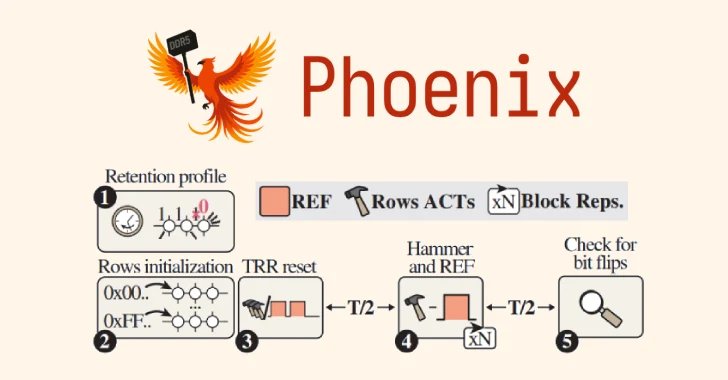
  1. New RowHammer Variant: A team from ETH Zürich and Google has identified a new RowHammer attack variant, codenamed Phoenix (CVE-2025-6202), targeting DDR5 memory from SK Hynix, capable of bypassing existing protections.

  2. Vulnerability Over Time: The RowHammer vulnerability exploits repeated memory access, leading to bit flips in adjacent rows, and newer DRAM chips, due to their scaling, are increasingly susceptible to these attacks.

  3. Privilege Escalation: The Phoenix attack can escalate privileges on DDR5 systems within 109 seconds, exploiting gaps in mitigation strategies that fail to refresh all chips effectively.

  4. Mitigation Recommendations: Researchers advise increasing the refresh rate of DDR5 memory to three times to prevent bit flips and mitigate the exploit, highlighting that existing memory cannot be updated post-deployment, leaving many systems vulnerable for years.

Phoenix RowHammer Attack Unveiled

A new variant of the RowHammer attack, dubbed Phoenix, poses significant threats to advanced DDR5 memory chips. Researchers from ETH Zürich and Google discovered this vulnerability in memory produced by SK Hynix. More importantly, Phoenix can bypass sophisticated protection mechanisms designed to prevent such exploits. While the concept of RowHammer has existed since 2014, this latest variant highlights the fragility of current defenses.

The Phoenix attack exploits a hardware vulnerability that triggers bit flips in adjacent memory rows. Consequently, this can lead to data corruption, privilege escalation, and unauthorized access. Researchers confirmed that existing error correction methods failed to thwart this new variant effectively. They noted that even on-die ECC protection could not stop Phoenix from executing attacks, which last just 109 seconds on desktop systems using DDR5 memory. This revelation indicates that current mitigation strategies may not be sufficient for future memory technologies.

Implications for the Future of Memory Security

As semiconductor companies aim for higher density DRAM chips, the susceptibility to RowHammer attacks increases. Researchers stress that newer memory architectures, specifically DDR5, might be more vulnerable due to their design. The narrowing activations needed to exploit these vulnerabilities pose risks for many computing environments, especially virtual machines.

The implications of the Phoenix exploit extend beyond immediate data corruption. It can potentially target secure keys like RSA-2048, undermining SSH authentication protocols. Even though some countermeasures exist, including increasing refresh rates, they may not be practical for all users. Researchers advocate raising refresh rates to mitigate risks effectively, but not all systems can implement such changes.

This discovery raises essential questions about the long-term applicability of memory security strategies. The ongoing advancements in memory technology necessitate renewed focus on hardware vulnerabilities, particularly as cyber threats continue to evolve. Addressing these challenges will require collaboration across industries to safeguard data integrity in an increasingly digital world.

Continue Your Tech Journey

Dive deeper into the world of Cryptocurrency and its impact on global finance.

Discover archived knowledge and digital history on the Internet Archive.

DataProtection-V1

Share. Facebook Twitter Pinterest LinkedIn Tumblr Email
Previous ArticleSecurity Experts Question Scattered Spider-ShinyHunters’ Retirement Claims
Next Article Jaguar Land Rover Delays Production Amid Cyberattack
Avatar photo
Staff Writer
  • Website

John Marcelli is a staff writer for the CISO Brief, with a passion for exploring and writing about the ever-evolving world of technology. From emerging trends to in-depth reviews of the latest gadgets, John stays at the forefront of innovation, delivering engaging content that informs and inspires readers. When he's not writing, he enjoys experimenting with new tech tools and diving into the digital landscape.

Related Posts

The Kill Chain Is Obsolete When Your AI Agent Becomes the Threat

March 25, 2026

LeakBase Admin Nabbed in Russia for Massive Credential Marketplace

March 25, 2026

Poland Battles Rising Cyberattacks in 2025, Targeting Energy Sector

March 24, 2026

Comments are closed.

Latest Posts

RedLine Infostealer Conspirator Extradited to U.S.

March 25, 2026

Pay2Key Ransomware Targets Organizations, Virtualization Hosts, and Cloud Workloads

March 25, 2026

New Research Reveals How Infostealer Infections Hit Dark Web in 48 Hours

March 25, 2026

500GB Stolen from Namibia Airports: A Wake-Up Call for Aviation Security

March 25, 2026
Don't Miss

The Kill Chain Is Obsolete When Your AI Agent Becomes the Threat

By Staff WriterMarch 25, 2026

Quick Takeaways AI-powered cyber espionage campaigns can bypass traditional detection by automating nearly all tactical…

LeakBase Admin Nabbed in Russia for Massive Credential Marketplace

March 25, 2026

Poland Battles Rising Cyberattacks in 2025, Targeting Energy Sector

March 24, 2026

Subscribe to Updates

Subscribe to our newsletter and never miss our latest news

Subscribe my Newsletter for New Posts & tips Let's stay updated!

Recent Posts

  • The Kill Chain Is Obsolete When Your AI Agent Becomes the Threat
  • RedLine Infostealer Conspirator Extradited to U.S.
  • CyberTech Daily: Top News & Insights
  • Pay2Key Ransomware Targets Organizations, Virtualization Hosts, and Cloud Workloads
  • LeakBase Admin Nabbed in Russia for Massive Credential Marketplace
About Us
About Us

Welcome to The CISO Brief, your trusted source for the latest news, expert insights, and developments in the cybersecurity world.

In today’s rapidly evolving digital landscape, staying informed about cyber threats, innovations, and industry trends is critical for professionals and organizations alike. At The CISO Brief, we are committed to providing timely, accurate, and insightful content that helps security leaders navigate the complexities of cybersecurity.

Facebook X (Twitter) Pinterest YouTube WhatsApp
Our Picks

The Kill Chain Is Obsolete When Your AI Agent Becomes the Threat

March 25, 2026

RedLine Infostealer Conspirator Extradited to U.S.

March 25, 2026

CyberTech Daily: Top News & Insights

March 25, 2026
Most Popular

Protecting MCP Security: Defeating Prompt Injection & Tool Poisoning

January 30, 202629 Views

The New Face of DDoS is Impacted by AI

August 4, 202523 Views

Absolute Launches GenAI Tools to Tackle Endpoint Risk

August 7, 202515 Views

Archives

  • March 2026
  • February 2026
  • January 2026
  • December 2025
  • November 2025
  • October 2025
  • September 2025
  • August 2025
  • July 2025
  • June 2025

Categories

  • Compliance
  • Cyber Updates
  • Cybercrime and Ransomware
  • Editor's pick
  • Emerging Tech
  • Events
  • Featured
  • Insights
  • Threat Intelligence
  • Uncategorized
© 2026 thecisobrief. Designed by thecisobrief.
  • Home
  • About Us
  • Advertise with Us
  • Contact Us
  • DMCA
  • Privacy Policy
  • Terms & Conditions

Type above and press Enter to search. Press Esc to cancel.