

Fast Facts
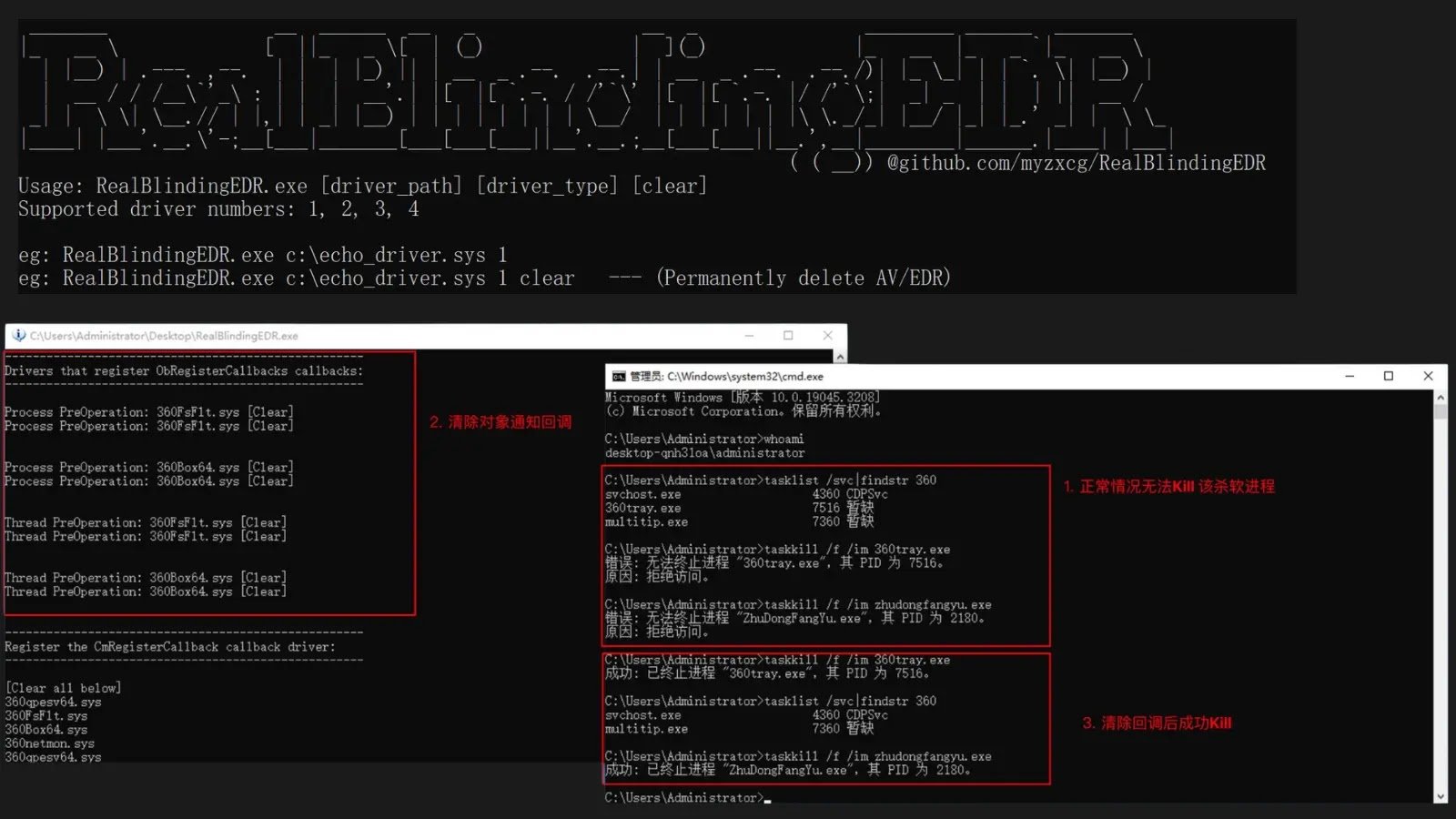
- RealBlindingEDR is an open-source tool that can permanently disable or blind antivirus and EDR software on Windows by erasing critical kernel callbacks, using signed drivers to bypass protections like PatchGuard.
- It targets multiple callback types related to process, thread, image loading, registry, and file monitoring, allowing attackers to evade detection and forcefully terminate security processes.
- The tool, designed for research but misused by ransomware groups like Crypto24, can modify kernel structures across Windows versions (7 to 11), enabling stealthy, persistent disabling of defenses.
- Security professionals are advised to monitor for signs such as suspicious driver loads and kernel anomalies, enforce driver signature policies, and review logs for unusual kernel or file activities to mitigate threats.
Underlying Problem
In late 2023, a powerful open-source tool named RealBlindingEDR was introduced on GitHub, designed to undermine the core defenses of Windows-based security solutions. By exploiting weaknesses in signed drivers to read and write directly to kernel memory, this tool can systematically erase critical callback functions—such as those monitoring process creation, file access, and registry changes—used by antivirus and endpoint detection systems. Its creators emphasize this development as a research project, but cybercriminal groups like Crypto24 have rapidly adopted it, deploying it in sophisticated ransomware attacks to disable defenses before executing payloads. The tool operates by locating and nullifying callback pointers within kernel structures, effectively blinding or permanently disabling security software, enabling malware to operate freely without detection or interruption.
The threat arises because RealBlindingEDR leverages vulnerabilities in widely used drivers to gain deep kernel-level access, allowing attackers to disable protective callbacks, terminate security processes, and delete protected files—actions that ensure malicious activities go unnoticed and unchecked. Attackers using this tool can stealthily avoid detection, even after reboots, by removing the hooks and protections security teams rely on. Incident reports indicate that the tool has been effective against popular security solutions like Windows Defender and Kaspersky, highlighting the urgent need for organizations to enforce strict driver signature policies, monitor kernel and driver activity for anomalies, and enhance behavioral analytics. While intended for research, the tool’s ease of use and potency have made it a significant asset for malicious actors, prompting cybersecurity professionals and vendors to develop and recommend countermeasures to mitigate its impact.
Risk Summary
RealBlindingEDR, an open-source tool released in late 2023, fundamentally undermines Windows endpoint security by exploiting signed, vulnerable drivers to permanently disable or blind antivirus (AV) and Endpoint Detection and Response (EDR) systems at the kernel level. By systematically erasing critical callback functions—such as process creation, thread activity, image loading, and registry change monitors—the utility enables attackers, including ransomware groups like Crypto24, to evade detection, terminate security processes, and delete protected files seamlessly, often surviving reboots. Its ease of use, relying only on administrator rights and signed drivers, significantly lowers the barrier for malicious actors, transforming it into a potent weapon for bypassing defenses without triggering safeguards like PatchGuard. The implications for cybersecurity are severe: it facilitates stealthy malicious operations, complicates incident response, and emphasizes the urgency for organizations to reinforce driver integrity enforcement, adopt behavioral analytics, and monitor kernel anomalies—highlighting a critical gap in current endpoint security strategies and the ongoing arms race at the kernel level.
Possible Action Plan
Understanding and addressing the timely remediation of the "RealBlindingEDR Tool That Permanently Turn off AV/EDR Using Kernel Callbacks" is essential because of its potential to eradicate vital security defenses, leaving systems vulnerable to malicious threats. Rapid response not only minimizes windows of exposure but also ensures the integrity and resilience of organizational cybersecurity postures.
Mitigation Steps
-
System Isolation
Immediately disconnect affected systems from networks to prevent lateral movement and data exfiltration during remediation. -
Identify Malicious Processes
Use trusted forensic tools to pinpoint the kernel callbacks and associated processes that disable the AV/EDR. -
Terminate Malicious Activity
Safely shut down or remove processes linked to the tool, ensuring minimal disruption to critical operations. -
Restore Security Services
Re-enable or reinstall the affected AV/EDR components, confirming their proper functionality. -
Apply Patches and Updates
Install the latest security patches and updates to close vulnerabilities exploited by the malicious tool. -
Audit and Monitor
Conduct comprehensive system audits followed by continuous monitoring to detect any residual or recurring malicious activity. - Implement Preventative Measures
Strengthen security policies, disable unnecessary kernel callbacks, and restrict privileges to hinder similar attacks in the future.
Explore More Security Insights
Explore career growth and education via Careers & Learning, or dive into Compliance essentials.
Understand foundational security frameworks via NIST CSF on Wikipedia.
Disclaimer: The information provided may not always be accurate or up to date. Please do your own research, as the cybersecurity landscape evolves rapidly. Intended for secondary references purposes only.
Cyberattacks-V1
