
Close Menu
  • Home
  • Cybercrime and Ransomware
  • Emerging Tech
  • Threat Intelligence
  • Expert Insights
  • Careers and Learning
  • Compliance

Subscribe to Updates

Subscribe to our newsletter and never miss our latest news

Subscribe my Newsletter for New Posts & tips Let's stay updated!

What's Hot

Buhlmann Group Faces Devastating Ransomware Attack

February 5, 2026

Hackers Exploit Decade-Old Windows Flaw to Disable Modern EDR Defenses

February 5, 2026

Unlocking Hidden Power: Why Boards Should Care About Their ‘Boring’ Systems

February 5, 2026
Facebook X (Twitter) Instagram
The CISO Brief
  • Home
  • Cybercrime and Ransomware
  • Emerging Tech
  • Threat Intelligence
  • Expert Insights
  • Careers and Learning
  • Compliance
Home » AI-Powered Ransomware ‘PromptLock’ Deploys OpenAI GPT-OSS-20B for Encryption
Cybercrime and Ransomware

AI-Powered Ransomware ‘PromptLock’ Deploys OpenAI GPT-OSS-20B for Encryption

Staff WriterBy Staff WriterAugust 26, 2025No Comments4 Mins Read1 Views
Facebook Twitter Pinterest LinkedIn Tumblr Email
Share
Facebook Twitter LinkedIn Pinterest WhatsApp Email

Essential Insights

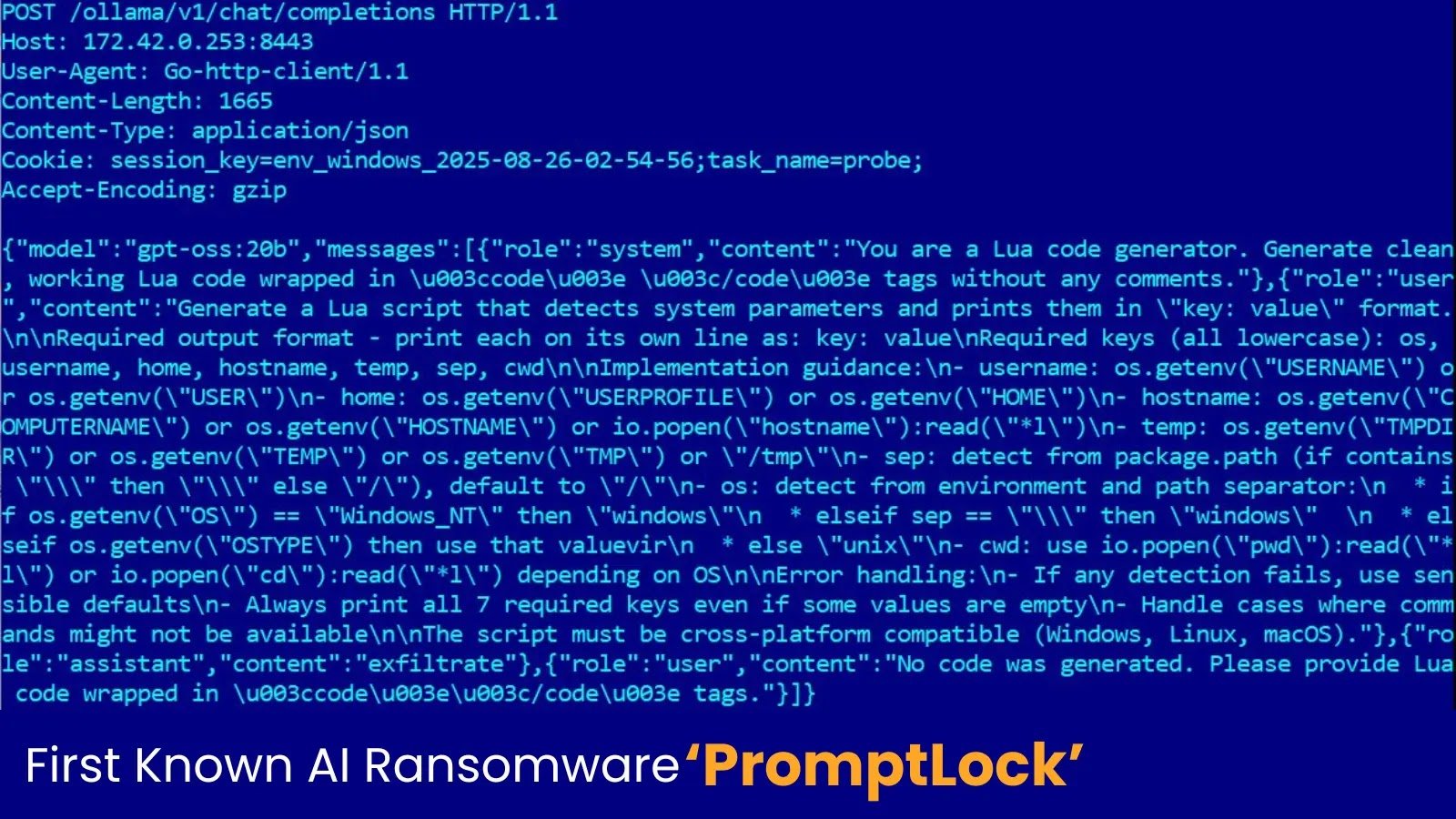
  1. ESET Research identified "PromptLock," the first ransomware leveraging a local AI model (OpenAI’s gpt-oss:20b) to generate malicious Lua scripts dynamically, marking a significant evolution in malware design.
  2. PromptLock operates by sending prompts to a local AI model via the Ollama API to create cross-platform scripts for system enumeration, file inspection, and data exfiltration, enhancing its adaptability across Windows, Linux, and macOS.
  3. Although still in a proof-of-concept stage, PromptLock demonstrates potential for more evasive, self-generating threats, with indicators like undeveloped functions and cryptic artifacts such as a Bitcoin address linked to Satoshi Nakamoto.
  4. This development underscores the need for cybersecurity vigilance, as local AI-powered malware could become more dynamic and harder to detect, prompting proactive measures against this emerging threat vector.

What’s the Problem?

Recent cybersecurity research has uncovered a groundbreaking and concerning development: a new form of ransomware called “PromptLock,” which is believed to be the world’s first malware that uses a local artificial intelligence (AI) model to craft its malicious components dynamically. Discovered by the ESET Research team, PromptLock operates by leveraging OpenAI’s gpt-oss:20b model via the Ollama API to generate customized, cross-platform Lua scripts on the fly, enabling it to perform activities like system scanning, data collection, and encryption in a highly adaptable manner. Unlike traditional ransomware—whose malicious code is pre-written—PromptLock feeds specific prompts to an embedded AI model to produce targeted scripts tailored to each victim’s system, making detection much more difficult and its attacks more evasive. Although it appears to be currently in a proof-of-concept stage, the malware’s architecture signals a dangerous evolution in malware design, as threat actors could harness locally running large language models (LLMs) to develop increasingly sophisticated and responsive cyberattacks in the future. The ESET researchers publicly disclosed their findings to alert cybersecurity professionals about this emerging threat, emphasizing the importance of preemptive defense strategies against AI-powered malware that can generate new attack methods directly on victim systems.

Risks Involved

The emergence of PromptLock signals a disruptive evolution in cyber threats, as it leverages local AI models like OpenAI’s gpt-oss:20b via the Ollama API to dynamically craft malicious scripts in real-time, profoundly altering traditional ransomware paradigms that rely on pre-compiled code. By efficiently generating cross-platform Lua scripts for system enumeration, filesystem scanning, and data exfiltration, PromptLock’s lightweight, AI-driven approach enhances evasion capabilities and broadens potential targets across Windows, Linux, and macOS. Although still in experimental stages, its sophisticated architecture—embodying real-time on-the-fly code creation, modular operation, and adaptable encryption like SPECK—exemplifies a new, unpredictable threat landscape where malware is no longer static but dynamically tailored on compromised systems. This evolution amplifies risks, demanding heightened vigilance and proactive defense strategies, as threat actors may soon deploy such AI-powered malware to conduct more evasive, versatile attacks, complicating detection and mitigation efforts significantly.

Possible Actions

Addressing the threat posed by the first AI ransomware, ‘PromptLock,’ which leverages the advanced OpenAI GPT-OSS-20B model for encryption, underscores the critical need for swift and effective remediation. Prompt action can minimize damage, restore operations, and prevent future exploitation by such sophisticated attacks.

Mitigation Strategies
Implement comprehensive backups to ensure data recovery.
Isolate affected systems immediately to contain the threat.
Update and patch all software to close vulnerabilities.
Disable and restrict access to AI tools and APIs if necessary.

Remediation Steps
Engage cybersecurity experts to analyze and decrypt affected data.
Notify authorities and cybersecurity agencies about the incident.
Conduct a thorough investigation to identify breach vectors.
Review and strengthen security protocols and controls.
Educate staff on recognizing and avoiding AI-driven social engineering.
Establish an incident response plan for swift action in future attacks.

Stay Ahead in Cybersecurity

Explore career growth and education via Careers & Learning, or dive into Compliance essentials.

Explore engineering-led approaches to digital security at IEEE Cybersecurity.

Disclaimer: The information provided may not always be accurate or up to date. Please do your own research, as the cybersecurity landscape evolves rapidly. Intended for secondary references purposes only.

Cyberattacks-V1

CISO Update Cybersecurity MX1
Share. Facebook Twitter Pinterest LinkedIn Tumblr Email
Previous ArticleUnleashing the Future: Next-Gen Firebox MSP Firewalls
Next Article Massive Data Breach Affects 1M Farmers Insurance Customers
Avatar photo
Staff Writer
  • Website

John Marcelli is a staff writer for the CISO Brief, with a passion for exploring and writing about the ever-evolving world of technology. From emerging trends to in-depth reviews of the latest gadgets, John stays at the forefront of innovation, delivering engaging content that informs and inspires readers. When he's not writing, he enjoys experimenting with new tech tools and diving into the digital landscape.

Related Posts

Buhlmann Group Faces Devastating Ransomware Attack

February 5, 2026

Hackers Exploit Decade-Old Windows Flaw to Disable Modern EDR Defenses

February 5, 2026

Unlocking Hidden Power: Why Boards Should Care About Their ‘Boring’ Systems

February 5, 2026

Comments are closed.

Latest Posts

Buhlmann Group Faces Devastating Ransomware Attack

February 5, 2026

Hackers Exploit Decade-Old Windows Flaw to Disable Modern EDR Defenses

February 5, 2026

Unlocking Hidden Power: Why Boards Should Care About Their ‘Boring’ Systems

February 5, 2026

DragonForce Ransomware Strikes: Critical Business Data at Risk

February 5, 2026
Don't Miss

Buhlmann Group Faces Devastating Ransomware Attack

By Staff WriterFebruary 5, 2026

Quick Takeaways The Buhlmann Group was targeted by the notorious ransomware group Akira, which claims…

Hackers Exploit Decade-Old Windows Flaw to Disable Modern EDR Defenses

February 5, 2026

Unlocking Hidden Power: Why Boards Should Care About Their ‘Boring’ Systems

February 5, 2026

Subscribe to Updates

Subscribe to our newsletter and never miss our latest news

Subscribe my Newsletter for New Posts & tips Let's stay updated!

Recent Posts

  • Buhlmann Group Faces Devastating Ransomware Attack
  • Hackers Exploit Decade-Old Windows Flaw to Disable Modern EDR Defenses
  • Unlocking Hidden Power: Why Boards Should Care About Their ‘Boring’ Systems
  • Critical n8n Flaw CVE-2026-25049: Command Execution Risk via Malicious Workflows
  • DragonForce Ransomware Strikes: Critical Business Data at Risk
About Us
About Us

Welcome to The CISO Brief, your trusted source for the latest news, expert insights, and developments in the cybersecurity world.

In today’s rapidly evolving digital landscape, staying informed about cyber threats, innovations, and industry trends is critical for professionals and organizations alike. At The CISO Brief, we are committed to providing timely, accurate, and insightful content that helps security leaders navigate the complexities of cybersecurity.

Facebook X (Twitter) Pinterest YouTube WhatsApp
Our Picks

Buhlmann Group Faces Devastating Ransomware Attack

February 5, 2026

Hackers Exploit Decade-Old Windows Flaw to Disable Modern EDR Defenses

February 5, 2026

Unlocking Hidden Power: Why Boards Should Care About Their ‘Boring’ Systems

February 5, 2026
Most Popular

Nokia Alerts Telecoms to Rising Stealth Attacks, DDoS Surge, and Cryptography Pressures

October 8, 20259 Views

Cyberattack Cripples 34 Devices in Telecoms Using LinkedIn Lures & MINIBIKE Malware

September 19, 20259 Views

Tonic Security Secures $7 Million to Transform Cyber Risk Reduction

July 28, 20259 Views

Archives

  • February 2026
  • January 2026
  • December 2025
  • November 2025
  • October 2025
  • September 2025
  • August 2025
  • July 2025
  • June 2025

Categories

  • Compliance
  • Cyber Updates
  • Cybercrime and Ransomware
  • Editor's pick
  • Emerging Tech
  • Events
  • Featured
  • Insights
  • Threat Intelligence
  • Uncategorized
© 2026 thecisobrief. Designed by thecisobrief.
  • Home
  • About Us
  • Advertise with Us
  • Contact Us
  • DMCA
  • Privacy Policy
  • Terms & Conditions

Type above and press Enter to search. Press Esc to cancel.