
Close Menu
  • Home
  • Cybercrime and Ransomware
  • Emerging Tech
  • Threat Intelligence
  • Expert Insights
  • Careers and Learning
  • Compliance

Subscribe to Updates

Subscribe to our newsletter and never miss our latest news

Subscribe my Newsletter for New Posts & tips Let's stay updated!

What's Hot

Strobes Security Welcomes Ed Adams as Strategic Advisor

March 18, 2026

Your Browser Turns Against You: The Rise of AI-Driven Attacks

March 18, 2026

Enhancing AI Systems: Unlocking Visibility for Proactive Risk Detection

March 18, 2026
Facebook X (Twitter) Instagram
The CISO Brief
  • Home
  • Cybercrime and Ransomware
  • Emerging Tech
  • Threat Intelligence
  • Expert Insights
  • Careers and Learning
  • Compliance
Home » Ransomware Attack Exposes Sensitive Kettering Health Data
Cybercrime and Ransomware

Ransomware Attack Exposes Sensitive Kettering Health Data

Staff WriterBy Staff WriterJune 5, 2025No Comments4 Mins Read2 Views
Facebook Twitter Pinterest LinkedIn Tumblr Email
Share
Facebook Twitter LinkedIn Pinterest WhatsApp Email

Summary Points

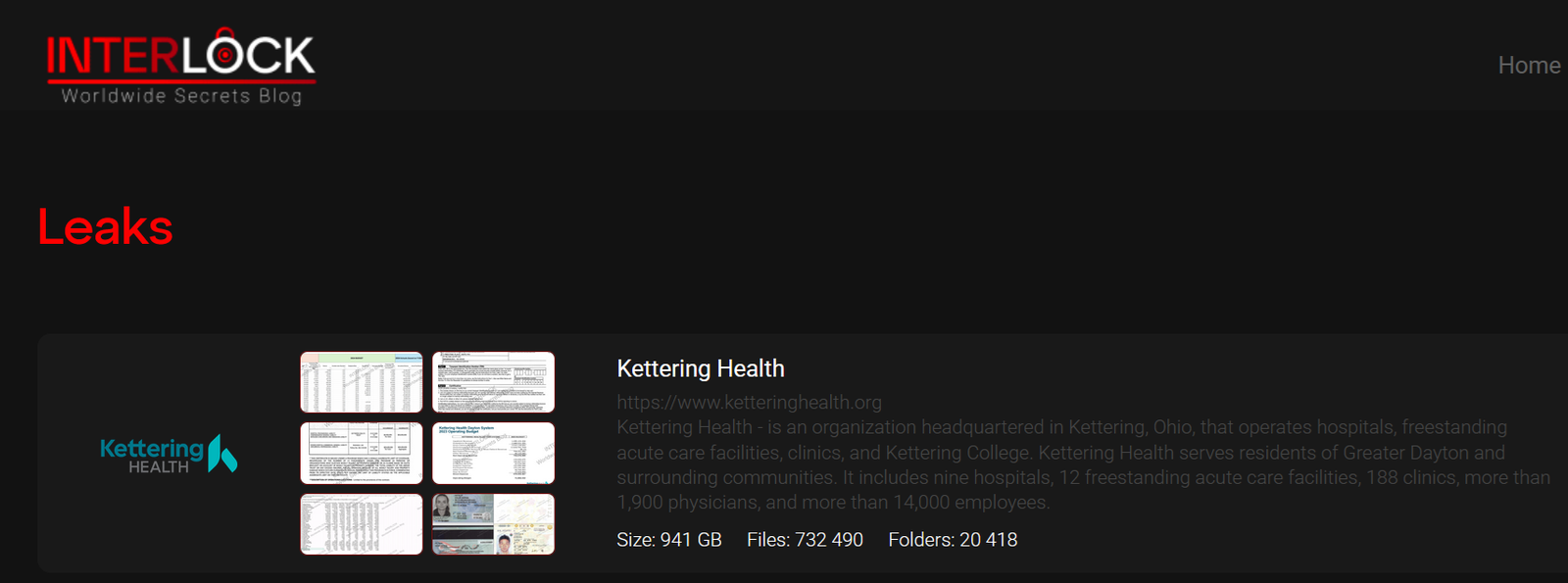
  1. Data Breach Impact: The Interlock ransomware gang claims to have stolen 941 GB of sensitive data from Kettering Health, including files like ID cards and financial reports.

  2. Cyberattack Response: Following a significant system outage caused by the cyberattack, Kettering Health managed to restore patient services and successfully launched its Epic electronic health record system.

  3. Ransom Payment Denied: Kettering Health did not comply with the extortion demands from Interlock, which resulted in the gang publishing the stolen data on their leak site.

  4. Enhanced Security Measures: In response to the attack, Kettering Health has eradicated the threat actors’ tools, patched systems, and improved its security protocols to prevent future incidents.

Underlying Problem

In a significant cybersecurity incident, the Interlock ransomware group claimed to have stolen an immense 941 GB of sensitive data from Kettering Health, a non-profit healthcare network in Ohio, which was left reeling from a recent cyberattack. This assault led the organization to temporarily suspend patient procedures as systems crucial for patient care, including its call center operations, became compromised. However, despite the initial disruptions, Kettering Health subsequently managed to restore key services and even reinforced its technological backbone with a new launch of its Epic electronic health record system, facilitating improved patient management.

The attack occurred on May 20, 2025, and is believed to have been executed by the Interlock group, which emphasized its role by leaking the stolen data on a Tor site. While Kettering Health has not disclosed specific details regarding the nature of the attack or whether a ransom was demanded or paid, it confirmed its response involved eradicating the attackers’ presence and fortifying security protocols to thwart future breaches. The healthcare provider assured stakeholders of the integrity and security of its systems amidst increasing scrutiny, as Interlock is linked to approximately 40 prior attacks targeting various entities, posing a growing risk in the cybersecurity landscape.

Critical Concerns

The recent cyberattack on Kettering Health by the Interlock ransomware gang, which led to the exfiltration of 941 GB of sensitive data, poses significant risks to other businesses, users, and organizations by creating a ripple effect of potential vulnerabilities in interconnected systems. As cybercriminals increasingly target healthcare and other critical sectors, the exposure of patient data—such as ID cards and financial information—raises severe concerns about identity theft and fraud, potentially jeopardizing not only patient trust but also affecting insurance companies, affiliated providers, and third-party vendors reliant on secure data exchanges. Moreover, organizations that share networks or data with Kettering Health could find themselves inadvertently drawn into similar attacks, amplifying the threat landscape. This incident underscores the urgent need for robust cybersecurity measures across all sectors, as the fallout from such breaches can erode customer confidence and engender substantial financial and reputational damages, fostering an environment of heightened distrust and regulatory scrutiny.

Possible Remediation Steps

In an era where data breaches proliferate, the timely remediation of compromised information is crucial, especially in light of alarming incidents like the recent ransomware gang leak of Kettering Health data.

Mitigation Steps:

  • Incident Detection: Implement real-time monitoring to identify breaches swiftly.
  • Immediate Containment: Isolate affected systems to prevent further data loss.
  • Data Restoration: Utilize backups to restore compromised information securely.
  • Vulnerability Assessment: Conduct thorough evaluations to identify and rectify security gaps.
  • Employee Training: Educate staff on recognizing suspicious activities and phishing attempts.
  • Communication Plan: Notify stakeholders transparently about the breach and remedial actions taken.

NIST CSF Guidance:
NIST’s Cybersecurity Framework (CSF) emphasizes the necessity for timely response to incidents and resilience against future threats. Key Special Publications (SP) guiding this include NIST SP 800-61, which provides a roadmap for incident response planning and execution. This framework underscores the importance of preparedness, ensuring that organizations can mitigate risks effectively and restore services expediently following a breach.

Stay Ahead in Cybersecurity

Explore career growth and education via Careers & Learning, or dive into Compliance essentials.

Understand foundational security frameworks via NIST CSF on Wikipedia.

Disclaimer: The information provided may not always be accurate or up to date. Please do your own research, as the cybersecurity landscape evolves rapidly. Intended for secondary references purposes only.

Cyberattacks-V1

CISO Update Cybersecurity data breach healthcare Kettering Health MX1 Ransomware
Share. Facebook Twitter Pinterest LinkedIn Tumblr Email
Previous Article‘PathWiper’ Attack Hits Critical Infrastructure In Ukraine
Next Article Trump’s Cyber Chief Nominee Sidesteps Funding Cut Backlash
Avatar photo
Staff Writer
  • Website

John Marcelli is a staff writer for the CISO Brief, with a passion for exploring and writing about the ever-evolving world of technology. From emerging trends to in-depth reviews of the latest gadgets, John stays at the forefront of innovation, delivering engaging content that informs and inspires readers. When he's not writing, he enjoys experimenting with new tech tools and diving into the digital landscape.

Related Posts

Your Browser Turns Against You: The Rise of AI-Driven Attacks

March 18, 2026

Enhancing AI Systems: Unlocking Visibility for Proactive Risk Detection

March 18, 2026

Uncovering the Hidden Pattern Behind Cisco’s Rising Vulnerabilities

March 18, 2026

Comments are closed.

Latest Posts

Uncovering the Hidden Pattern Behind Cisco’s Rising Vulnerabilities

March 18, 2026

Critical Firewall Zero-Day Breach Sparks Interlock Ransomware Attacks

March 18, 2026

New iOS Exploit: Advanced Tools Targeting iPhone Users to Steal Personal Data

March 18, 2026

FancyBear Server Leak Exposes Credentials, 2FA Secrets, and NATO-Linked Targets

March 18, 2026
Don't Miss

Your Browser Turns Against You: The Rise of AI-Driven Attacks

By Staff WriterMarch 18, 2026

Summary Points AI-powered browsers like Perplexity’s Comet can be hijacked through hidden prompt injections, leading…

Enhancing AI Systems: Unlocking Visibility for Proactive Risk Detection

March 18, 2026

Uncovering the Hidden Pattern Behind Cisco’s Rising Vulnerabilities

March 18, 2026

Subscribe to Updates

Subscribe to our newsletter and never miss our latest news

Subscribe my Newsletter for New Posts & tips Let's stay updated!

Recent Posts

  • Strobes Security Welcomes Ed Adams as Strategic Advisor
  • Your Browser Turns Against You: The Rise of AI-Driven Attacks
  • Enhancing AI Systems: Unlocking Visibility for Proactive Risk Detection
  • C2 Implant ‘SnappyClient’ Turns Its Focus to Crypto Wallets
  • Uncovering the Hidden Pattern Behind Cisco’s Rising Vulnerabilities
About Us
About Us

Welcome to The CISO Brief, your trusted source for the latest news, expert insights, and developments in the cybersecurity world.

In today’s rapidly evolving digital landscape, staying informed about cyber threats, innovations, and industry trends is critical for professionals and organizations alike. At The CISO Brief, we are committed to providing timely, accurate, and insightful content that helps security leaders navigate the complexities of cybersecurity.

Facebook X (Twitter) Pinterest YouTube WhatsApp
Our Picks

Strobes Security Welcomes Ed Adams as Strategic Advisor

March 18, 2026

Your Browser Turns Against You: The Rise of AI-Driven Attacks

March 18, 2026

Enhancing AI Systems: Unlocking Visibility for Proactive Risk Detection

March 18, 2026
Most Popular

Protecting MCP Security: Defeating Prompt Injection & Tool Poisoning

January 30, 202624 Views

The New Face of DDoS is Impacted by AI

August 4, 202523 Views

Absolute Launches GenAI Tools to Tackle Endpoint Risk

August 7, 202515 Views

Archives

  • March 2026
  • February 2026
  • January 2026
  • December 2025
  • November 2025
  • October 2025
  • September 2025
  • August 2025
  • July 2025
  • June 2025

Categories

  • Compliance
  • Cyber Updates
  • Cybercrime and Ransomware
  • Editor's pick
  • Emerging Tech
  • Events
  • Featured
  • Insights
  • Threat Intelligence
  • Uncategorized
© 2026 thecisobrief. Designed by thecisobrief.
  • Home
  • About Us
  • Advertise with Us
  • Contact Us
  • DMCA
  • Privacy Policy
  • Terms & Conditions

Type above and press Enter to search. Press Esc to cancel.