
Close Menu
  • Home
  • Cybercrime and Ransomware
  • Emerging Tech
  • Threat Intelligence
  • Expert Insights
  • Careers and Learning
  • Compliance

Subscribe to Updates

Subscribe to our newsletter and never miss our latest news

Subscribe my Newsletter for New Posts & tips Let's stay updated!

What's Hot

Enhancing Federal Security: Claroty & Corsha Combine OT Threat Detection with Machine Identity Protection

May 26, 2026

Stop Using AI Governance as Just a Review Layer — Unleash Its Infrastructure Power

May 26, 2026

Ransomware Leverages ChaCha20 & Curve25519 to Encrypt Windows Files

May 26, 2026
Facebook X (Twitter) Instagram
The CISO Brief
  • Home
  • Cybercrime and Ransomware
  • Emerging Tech
  • Threat Intelligence
  • Expert Insights
  • Careers and Learning
  • Compliance
Home » NVIDIA Triton Bugs Let Unauthenticated Attackers Execute Code and Hijack AI Servers
Uncategorized

NVIDIA Triton Bugs Let Unauthenticated Attackers Execute Code and Hijack AI Servers

Staff WriterBy Staff WriterAugust 4, 2025No Comments3 Mins Read5 Views
Facebook Twitter Pinterest LinkedIn Tumblr Email
Share
Facebook Twitter LinkedIn Pinterest WhatsApp Email


Aug 04, 2025Ravie LakshmananAI Security / Vulnerability

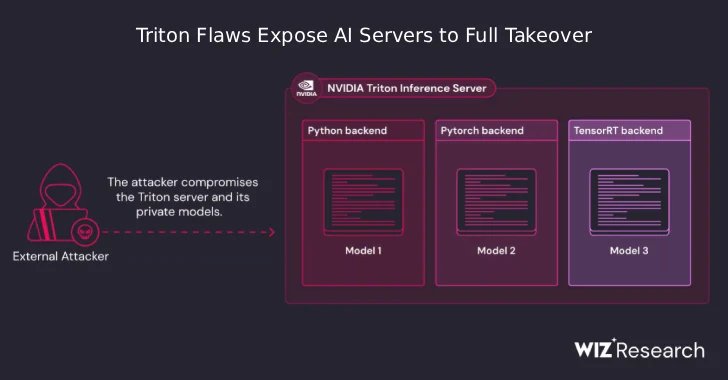
A newly disclosed set of security flaws in NVIDIA’s Triton Inference Server for Windows and Linux, an open-source platform for running artificial intelligence (AI) models at scale, could be exploited to take over susceptible servers.

“When chained together, these flaws can potentially allow a remote, unauthenticated attacker to gain complete control of the server, achieving remote code execution (RCE),” Wiz researchers Ronen Shustin and Nir Ohfeld said in a report published today.

The vulnerabilities are listed below –

CVE-2025-23319 (CVSS score: 8.1) – A vulnerability in the Python backend, where an attacker could cause an out-of-bounds write by sending a request
CVE-2025-23320 (CVSS score: 7.5) – A vulnerability in the Python backend, where an attacker could cause the shared memory limit to be exceeded by sending a very large request
CVE-2025-23334 (CVSS score: 5.9) – A vulnerability in the Python backend, where an attacker could cause an out-of-bounds read by sending a request

Successful exploitation of the aforementioned vulnerabilities could result in information disclosure, as well as remote code execution, denial of service, data tampering in the case of CVE-2025-23319. The issues have been addressed in version 25.07.

The cloud security company said the three shortcomings could be combined together that transforms the problem from an information leak to a full system compromise without requiring any credentials.

Identity Security Risk Assessment

Specifically, the problems are rooted in the Python backend that’s designed to handle inference requests for Python models from any major AI frameworks such as PyTorch and TensorFlow.

In the attack outlined by Wiz, a threat actor could exploit CVE-2025-23320 to leak the full, unique name of the backend’s internal IPC shared memory region, a key that should have remained private, and then leverage the remaining two flaws to gain full control of the inference server.

“This poses a critical risk to organizations using Triton for AI/ML, as a successful attack could lead to the theft of valuable AI models, exposure of sensitive data, manipulating the AI model’s responses, and a foothold for attackers to move deeper into a network,” the researchers said.

NVIDIA’s August bulletin for Triton Inference Server also highlights fixes for three critical bugs (CVE-2025-23310, CVE-2025-23311, and CVE-2025-23317) that, if successfully exploited, could result in remote code execution, denial of service, information disclosure, and data tampering.

While there is no evidence that any of these vulnerabilities have been exploited in the wild, users are advised to apply the latest updates for optimal protection.


Source link

Share. Facebook Twitter Pinterest LinkedIn Tumblr Email
Previous ArticleRansomware Gangs Thrive on Rival Eliminations
Next Article Chanel Under Siege: Major Data Theft Hits Fashion Icon
Avatar photo
Staff Writer
  • Website

John Marcelli is a staff writer for the CISO Brief, with a passion for exploring and writing about the ever-evolving world of technology. From emerging trends to in-depth reviews of the latest gadgets, John stays at the forefront of innovation, delivering engaging content that informs and inspires readers. When he's not writing, he enjoys experimenting with new tech tools and diving into the digital landscape.

Related Posts

Critical Breach: Internal Repositories Compromised via Malicious Nx Console Extension

May 21, 2026

Grafana GitHub Breach: TanStack npm Attack Exposes Source Code

May 20, 2026

Funnel Builder Flaw Lets Hackers Skim WooCommerce Checkouts

May 16, 2026
Leave A Reply Cancel Reply

Latest Posts

Enhancing Federal Security: Claroty & Corsha Combine OT Threat Detection with Machine Identity Protection

May 26, 2026

Stop Using AI Governance as Just a Review Layer — Unleash Its Infrastructure Power

May 26, 2026

Ransomware Leverages ChaCha20 & Curve25519 to Encrypt Windows Files

May 26, 2026

Vulnerabilities: Cyber Attackers’ Number One Entry Point

May 26, 2026
Don't Miss

Critical Breach: Internal Repositories Compromised via Malicious Nx Console Extension

By Staff WriterMay 21, 2026

Quick Takeaways GitHub confirmed a breach due to a compromised employee device that injected malicious…

Grafana GitHub Breach: TanStack npm Attack Exposes Source Code

May 20, 2026

Funnel Builder Flaw Lets Hackers Skim WooCommerce Checkouts

May 16, 2026

Subscribe to Updates

Subscribe to our newsletter and never miss our latest news

Subscribe my Newsletter for New Posts & tips Let's stay updated!

Recent Posts

  • Enhancing Federal Security: Claroty & Corsha Combine OT Threat Detection with Machine Identity Protection
  • Stop Using AI Governance as Just a Review Layer — Unleash Its Infrastructure Power
  • Ransomware Leverages ChaCha20 & Curve25519 to Encrypt Windows Files
  • Vulnerabilities: Cyber Attackers’ Number One Entry Point
  • Researchers reveal LLM exploitation in cyber threat data.
About Us
About Us

Welcome to The CISO Brief, your trusted source for the latest news, expert insights, and developments in the cybersecurity world.

In today’s rapidly evolving digital landscape, staying informed about cyber threats, innovations, and industry trends is critical for professionals and organizations alike. At The CISO Brief, we are committed to providing timely, accurate, and insightful content that helps security leaders navigate the complexities of cybersecurity.

Facebook X (Twitter) Pinterest YouTube WhatsApp
Our Picks

Enhancing Federal Security: Claroty & Corsha Combine OT Threat Detection with Machine Identity Protection

May 26, 2026

Stop Using AI Governance as Just a Review Layer — Unleash Its Infrastructure Power

May 26, 2026

Ransomware Leverages ChaCha20 & Curve25519 to Encrypt Windows Files

May 26, 2026
Most Popular

Protecting MCP Security: Defeating Prompt Injection & Tool Poisoning

January 30, 202632 Views

Unlock the Power of Free WormGPT: Harnessing DeepSeek, Gemini, and Kimi-K2 AI Models

November 27, 202530 Views

The New Face of DDoS is Impacted by AI

August 4, 202528 Views

Archives

  • May 2026
  • April 2026
  • March 2026
  • February 2026
  • January 2026
  • December 2025
  • November 2025
  • October 2025
  • September 2025
  • August 2025
  • July 2025
  • June 2025

Categories

  • Compliance
  • Cyber Updates
  • Cybercrime and Ransomware
  • Editor's pick
  • Emerging Tech
  • Events
  • Featured
  • Insights
  • Most Read
  • Threat Intelligence
  • Uncategorized
© 2026 thecisobrief. Designed by thecisobrief.
  • Home
  • About Us
  • Advertise with Us
  • Contact Us
  • DMCA
  • Privacy Policy
  • Terms & Conditions

Type above and press Enter to search. Press Esc to cancel.