
Close Menu
  • Home
  • Cybercrime and Ransomware
  • Emerging Tech
  • Threat Intelligence
  • Expert Insights
  • Careers and Learning
  • Compliance

Subscribe to Updates

Subscribe to our newsletter and never miss our latest news

Subscribe my Newsletter for New Posts & tips Let's stay updated!

What's Hot

Critical Breach: Internal Repositories Compromised via Malicious Nx Console Extension

May 21, 2026

Dark Web Brokers Resell Old Breaches as New Corporate Data Leaks

May 21, 2026

Chainguard and FINOS Lead the AI Supply Chain Security Revolution

May 20, 2026
Facebook X (Twitter) Instagram
The CISO Brief
  • Home
  • Cybercrime and Ransomware
  • Emerging Tech
  • Threat Intelligence
  • Expert Insights
  • Careers and Learning
  • Compliance
Home » Cyber Criminals Exploit Open-Source Tools to Compromise Financial Institutions Across Africa
Cybercrime and Ransomware

Cyber Criminals Exploit Open-Source Tools to Compromise Financial Institutions Across Africa

Staff WriterBy Staff WriterJune 26, 2025No Comments3 Mins Read14 Views
Facebook Twitter Pinterest LinkedIn Tumblr Email
Share
Facebook Twitter LinkedIn Pinterest WhatsApp Email


Jun 26, 2025Ravie LakshmananThreat Intelligence / Ransomware

Cybersecurity researchers are calling attention to a series of cyber attacks targeting financial organizations across Africa since at least July 2023 using a mix of open-source and publicly available tools to maintain access.

Palo Alto Networks Unit 42 is tracking the activity under the moniker CL-CRI-1014, where “CL” refers to “cluster” and “CRI” stands for “criminal motivation.”

It’s suspected that the end goal of the attacks is to obtain initial access and then sell it to other criminal actors on underground forums, making the threat actor an initial access broker (IAB).

“The threat actor copies signatures from legitimate applications to forge file signatures, to disguise their toolset and mask their malicious activities,” researchers Tom Fakterman and Guy Levi said. “Threat actors often spoof legitimate products for malicious purposes.”

Cybersecurity

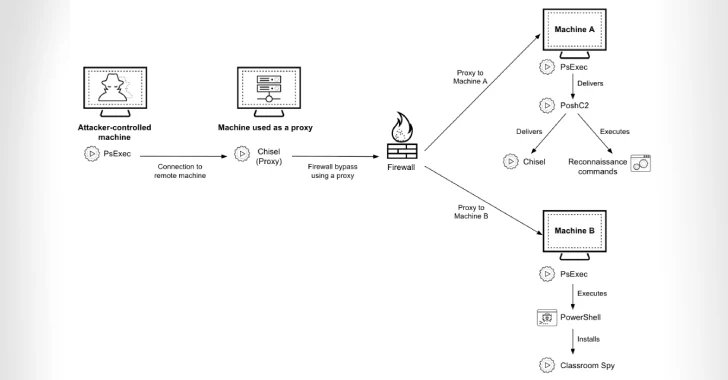
The attacks are characterized by the deployment of tools like PoshC2 for command-and-control (C2), Chisel for tunneling malicious network traffic, and Classroom Spy for remote administration.

The exact method the threat actors use to breach target networks is not clear. Once a foothold is obtained, the attack chains have been found to deploy MeshCentral Agent and later Classroom Spy to commandeer the machines, and then drop Chisel to bypass firewalls and spread PoshC2 to other Windows hosts on the compromised network.

To sidestep detection efforts, the payloads are passed off as legitimate software, using the icons of Microsoft Teams, Palo Alto Networks Cortex, and Broadcom VMware Tools. PoshC2 is persisted on the systems using three different methods –

Setting up a service
Saving a Windows shortcut (LNK) file to the tool in the Startup folder
Using a scheduled task under the name “Palo Alto Cortex Services”

In some incidents observed by the cybersecurity company, the threat actors are said to have stolen user credentials and used them to set up a proxy using PoshC2.

“PoshC2 can use a proxy to communicate with a command-and-control (C2) server, and it appears that the threat actor tailored some of the PoshC2 implants specifically for the targeted environment,” the researchers noted.

This is not the first time PoshC2 has been used in attacks aimed at financial services in Africa. In September 2022, Check Point detailed a spear-phishing campaign dubbed DangerousSavanna that targeted financial and insurance companies located in Ivory Coast, Morocco, Cameroon, Senegal, and Togo to deliver Metasploit, PoshC2, DWservice, and AsyncRAT.

Cybersecurity

The disclosure comes as Trustwave SpiderLabs shed light on a new ransomware group called Dire Wolf that has already claimed 16 victims across the U.S., Thailand, Taiwan, Australia, Bahrain, Canada, India, Italy, Peru, and Singapore since its emergence last month. The top targeted sectors are technology, manufacturing, and financial services.

Analysis of the Dire Wolf locker has revealed that it’s written in Golang, and comes with capabilities to disable system logging, terminate a hard-coded list of 75 services and 59 applications, and inhibit recovery efforts by deleting shadow copies.

“Although no initial access, reconnaissance or lateral movement techniques used by Dire Wolf are known at this point, organizations shall follow good security practices as well as enable monitoring for the techniques revealed in this analysis,” the company said.

Found this article interesting? Follow us on Twitter  and LinkedIn to read more exclusive content we post.


Source link

Share. Facebook Twitter Pinterest LinkedIn Tumblr Email
Previous ArticleMassive Data Breach Affects 167,000 in Central Kentucky
Next Article British Hacker IntelBroker Arrested: Suspected Cyber Intruder in Custody
Avatar photo
Staff Writer
  • Website

John Marcelli is a staff writer for the CISO Brief, with a passion for exploring and writing about the ever-evolving world of technology. From emerging trends to in-depth reviews of the latest gadgets, John stays at the forefront of innovation, delivering engaging content that informs and inspires readers. When he's not writing, he enjoys experimenting with new tech tools and diving into the digital landscape.

Related Posts

Dark Web Brokers Resell Old Breaches as New Corporate Data Leaks

May 21, 2026

Void Botnet Harnesses Ethereum Smart Contracts for Secure C2 Control

May 20, 2026

GitHub: Internal Repositories Affected by Poisoned VS Code Extension Attack

May 20, 2026
Leave A Reply Cancel Reply

Latest Posts

Dark Web Brokers Resell Old Breaches as New Corporate Data Leaks

May 21, 2026

Void Botnet Harnesses Ethereum Smart Contracts for Secure C2 Control

May 20, 2026

GitHub: Internal Repositories Affected by Poisoned VS Code Extension Attack

May 20, 2026

Grafana GitHub Breach Tied to Ransomware Attack on TanStack npm Supply Chain

May 20, 2026
Don't Miss

Dark Web Brokers Resell Old Breaches as New Corporate Data Leaks

By Staff WriterMay 21, 2026

Summary Points Most data being sold on dark web forums are recycled from previous breaches,…

Void Botnet Harnesses Ethereum Smart Contracts for Secure C2 Control

May 20, 2026

GitHub: Internal Repositories Affected by Poisoned VS Code Extension Attack

May 20, 2026

Subscribe to Updates

Subscribe to our newsletter and never miss our latest news

Subscribe my Newsletter for New Posts & tips Let's stay updated!

Recent Posts

  • Critical Breach: Internal Repositories Compromised via Malicious Nx Console Extension
  • Dark Web Brokers Resell Old Breaches as New Corporate Data Leaks
  • Chainguard and FINOS Lead the AI Supply Chain Security Revolution
  • Void Botnet Harnesses Ethereum Smart Contracts for Secure C2 Control
  • Cyber Experts Clash: Is AI a Savior or a Threat?
About Us
About Us

Welcome to The CISO Brief, your trusted source for the latest news, expert insights, and developments in the cybersecurity world.

In today’s rapidly evolving digital landscape, staying informed about cyber threats, innovations, and industry trends is critical for professionals and organizations alike. At The CISO Brief, we are committed to providing timely, accurate, and insightful content that helps security leaders navigate the complexities of cybersecurity.

Facebook X (Twitter) Pinterest YouTube WhatsApp
Our Picks

Critical Breach: Internal Repositories Compromised via Malicious Nx Console Extension

May 21, 2026

Dark Web Brokers Resell Old Breaches as New Corporate Data Leaks

May 21, 2026

Chainguard and FINOS Lead the AI Supply Chain Security Revolution

May 20, 2026
Most Popular

Protecting MCP Security: Defeating Prompt Injection & Tool Poisoning

January 30, 202632 Views

Unlock the Power of Free WormGPT: Harnessing DeepSeek, Gemini, and Kimi-K2 AI Models

November 27, 202530 Views

The New Face of DDoS is Impacted by AI

August 4, 202527 Views

Archives

  • May 2026
  • April 2026
  • March 2026
  • February 2026
  • January 2026
  • December 2025
  • November 2025
  • October 2025
  • September 2025
  • August 2025
  • July 2025
  • June 2025

Categories

  • Compliance
  • Cyber Updates
  • Cybercrime and Ransomware
  • Editor's pick
  • Emerging Tech
  • Events
  • Featured
  • Insights
  • Most Read
  • Threat Intelligence
  • Uncategorized
© 2026 thecisobrief. Designed by thecisobrief.
  • Home
  • About Us
  • Advertise with Us
  • Contact Us
  • DMCA
  • Privacy Policy
  • Terms & Conditions

Type above and press Enter to search. Press Esc to cancel.