
Close Menu
  • Home
  • Cybercrime and Ransomware
  • Emerging Tech
  • Threat Intelligence
  • Expert Insights
  • Careers and Learning
  • Compliance

Subscribe to Updates

Subscribe to our newsletter and never miss our latest news

Subscribe my Newsletter for New Posts & tips Let's stay updated!

What's Hot

Fake Teams Support, Stolen Company Data

November 2, 2026

Security That Survives 2027
Build for what’s next.

November 2, 2026

Volt Typhoon May Be Preparing to Strike Critical Infrastructure

November 2, 2026
Facebook X (Twitter) Instagram
The CISO Brief
  • Home
  • Cybercrime and Ransomware
  • Emerging Tech
  • Threat Intelligence
  • Expert Insights
  • Careers and Learning
  • Compliance
Home » Fake Teams Support, Stolen Company Data
Uncategorized

Fake Teams Support, Stolen Company Data

Staff WriterBy Staff WriterNovember 2, 2026No Comments3 Mins Read0 Views
Facebook Twitter Pinterest LinkedIn Tumblr Email
Share
Facebook Twitter LinkedIn Pinterest WhatsApp Email

Fast Facts

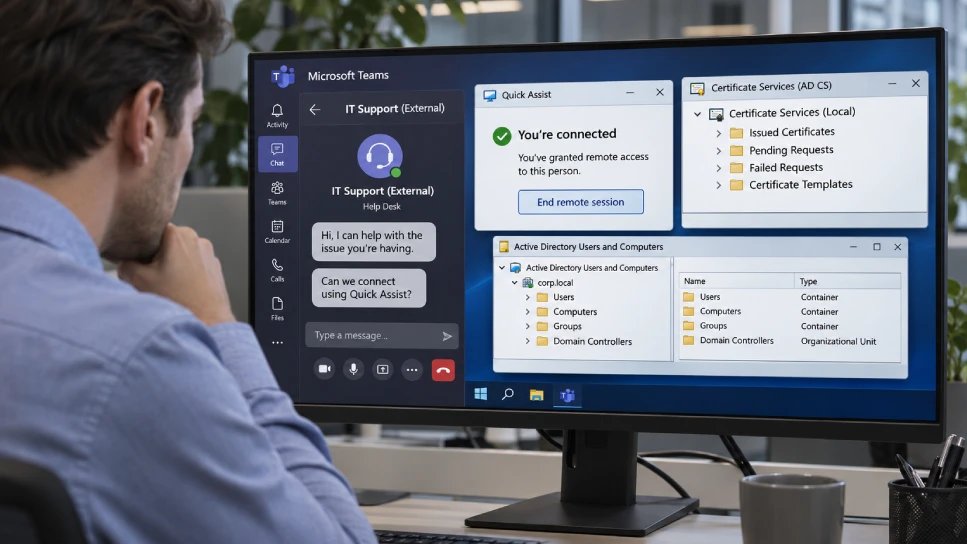
  1. Fake IT support opened the door: Attackers used Microsoft Teams and Quick Assist to gain hands-on control of employees’ PCs—without exploiting a Teams flaw.
  2. Misconfigured AD CS enabled privilege escalation: ESC1 and ESC8 techniques let attackers obtain certificates for privileged accounts, including a domain controller.
  3. One intrusion led to credential theft attempts and data theft: A missed containment exception left an account active; another attack was stopped by isolating a workstation.
  4. Harden identity systems and close response gaps: Review certificate templates and enrollment endpoints, verify support requests, audit certificates, and ensure every excluded account has a manual containment plan.

Familiar Support Requests Opened the Door

Attackers posing as company IT staff used Microsoft Teams to persuade employees to share control of their computers, Microsoft reported. They contacted workers from outside accounts with support-themed names, then asked them to open Quick Assist, a Windows remote-help tool, and read out a connection code.

The attackers used that access to run malicious files and target weaknesses in Active Directory Certificate Services (AD CS), which issues digital certificates that help verify identities. In simple terms, a certificate can function like a trusted login credential. Poorly configured settings let attackers obtain certificates for privileged accounts, including a domain controller.

Microsoft investigated two intrusions. In the first, attackers gained certificates for multiple privileged accounts and accessed a domain controller. Security tools blocked much of their activity, but one account escaped automatic containment. The attackers used it to reach a file server and copy company data to an external server. Microsoft did not say how much data they took.

In the second intrusion, attackers used a different certificate weakness to impersonate a domain controller. This time, the company isolated the affected workstation, and Microsoft reported no further activity. The incidents did not exploit a flaw in Teams, and Microsoft did not link them to a known group.

Verification and Configuration Matter

The cases show how everyday tools can become attack paths when people trust an unexpected support request. Remote assistance can help teams solve problems quickly, but employees should confirm surprise requests through a known internal channel before sharing screen access.

Organizations should also review who can request identity certificates and tighten unsafe AD CS settings. Microsoft recommends securing certificate web-enrollment services, monitoring certificate activity, and ensuring every privileged account has a clear containment plan. Resetting a password or wiping a computer may not end access if an attacker still holds a valid certificate or login ticket.

These steps require careful setup, but they build on tools and controls many companies already use. As remote work and digital support become routine, pairing convenience with verification can help protect both employees and company data.

Discover More Technology Insights

Stay informed on the revolutionary breakthroughs in Quantum Computing research.

Discover archived knowledge and digital history on the Internet Archive.

DataProtection-V1

Share. Facebook Twitter Pinterest LinkedIn Tumblr Email
Previous Article

Security That Survives 2027
Build for what’s next.

Avatar photo
Staff Writer
  • Website

John Marcelli is a staff writer for the CISO Brief, with a passion for exploring and writing about the ever-evolving world of technology. From emerging trends to in-depth reviews of the latest gadgets, John stays at the forefront of innovation, delivering engaging content that informs and inspires readers. When he's not writing, he enjoys experimenting with new tech tools and diving into the digital landscape.

Related Posts

Hackers Steal $2.7M from Polymarket Traders via Hijacked Script

November 1, 2026

Chainalysis Breach Exposes Customer Identity Data

October 31, 2026

Binance Breach Hits $6.3B in Assets; Nearly $3B Frozen

October 30, 2026

Comments are closed.

Latest Posts

Security That Survives 2027
Build for what’s next.

November 2, 2026

Volt Typhoon May Be Preparing to Strike Critical Infrastructure

November 2, 2026

Hacktober: Cyberattacks Strike PHP, Binance, the Pentagon & More

November 1, 2026

When Worms Think: Is Your SOC Ready?

November 1, 2026
Don't Miss

Hackers Steal $2.7M from Polymarket Traders via Hijacked Script

By Staff WriterNovember 1, 2026

Quick Takeaways A compromised DebugBear script injected malicious code into Polymarket after DebugBear’s DNS was…

Chainalysis Breach Exposes Customer Identity Data

October 31, 2026

Binance Breach Hits $6.3B in Assets; Nearly $3B Frozen

October 30, 2026

Subscribe to Updates

Subscribe to our newsletter and never miss our latest news

Subscribe my Newsletter for New Posts & tips Let's stay updated!

Recent Posts

  • Fake Teams Support, Stolen Company Data

  • Security That Survives 2027
    Build for what’s next.

  • Volt Typhoon May Be Preparing to Strike Critical Infrastructure

  • 2026 Agentic Security Operations Report
    Discover how AI agents are transforming cyber defense.

  • Hacktober: Cyberattacks Strike PHP, Binance, the Pentagon & More

About Us
About Us

Welcome to The CISO Brief, your trusted source for the latest news, expert insights, and developments in the cybersecurity world.

In today’s rapidly evolving digital landscape, staying informed about cyber threats, innovations, and industry trends is critical for professionals and organizations alike. At The CISO Brief, we are committed to providing timely, accurate, and insightful content that helps security leaders navigate the complexities of cybersecurity.

Facebook X (Twitter) Pinterest YouTube WhatsApp
Our Picks

Fake Teams Support, Stolen Company Data

November 2, 2026

Security That Survives 2027
Build for what’s next.

November 2, 2026

Volt Typhoon May Be Preparing to Strike Critical Infrastructure

November 2, 2026
Most Popular

Gefährliche Angriffe: Wie Cyberkriminelle Ihre Identität angreifen

January 29, 2026353 Views

Fortinet VPN vulnerability exploited for remote access compromise

June 19, 2026231 Views

Salesforce Disables Klue App After Data Breach from Token Abuse

June 19, 2026217 Views

Archives

  • November 2026
  • October 2026
  • September 2026
  • August 2026
  • July 2026
  • June 2026
  • May 2026
  • April 2026
  • March 2026
  • February 2026
  • January 2026
  • December 2025
  • November 2025
  • October 2025
  • September 2025
  • August 2025
  • July 2025
  • June 2025

Categories

  • Compliance
  • Cyber Updates
  • Cybercrime and Ransomware
  • Editor's pick
  • Emerging Tech
  • Events
  • Featured
  • Insights
  • Most Read
  • Threat Intelligence
  • Uncategorized
© 2026 thecisobrief. Designed by thecisobrief.
  • Home
  • About Us
  • Advertise with Us
  • Contact Us
  • DMCA
  • Privacy Policy
  • Terms & Conditions

Type above and press Enter to search. Press Esc to cancel.