

Fast Facts
- Bryson Bort emphasizes that true cybersecurity resilience, especially for critical infrastructure, hinges on systemic, disciplined action that prioritizes people, understanding that users are the largest risk surface.
- He advocates for integrating threat-informed defense, emulation, and cultural shifts to foster shared responsibility and operational resilience in industrial environments.
- Bort highlights the importance of collaboration, transparency, and trust among public, private, and academic sectors to strengthen collective cybersecurity defense.
- He warns that misconceptions like "compliance equals security" hinder progress, advocating instead for measurable, threat-informed strategies and continuous validation to enhance societal protection.
What’s the Problem?
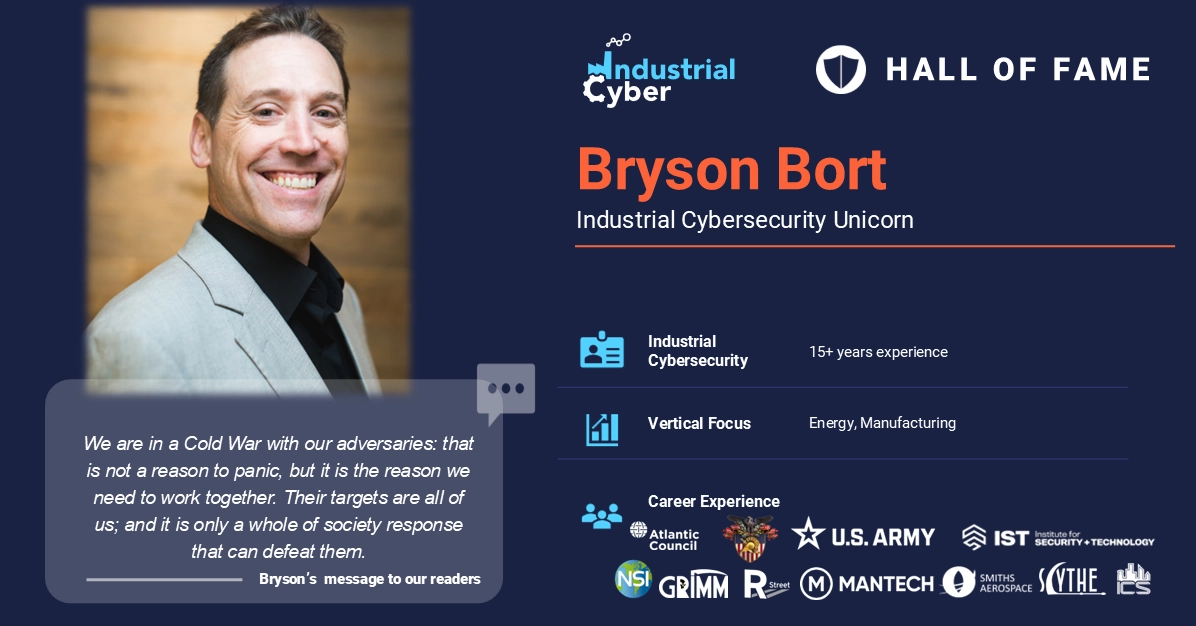
Bryson Bort, a military veteran turned cybersecurity innovator and leader, recounts his journey from serving as a Battle Captain in Iraq to founding influential organizations like SCYTHE and GRIMM Cyber. His shift from military intelligence to cybersecurity stemmed from a desire to protect critical infrastructure, emphasizing that resilience depends not just on advanced technology but crucially on the human element—people are the largest risk surface. Bort advocates for a systemic, people-centered approach to cybersecurity, stressing that public and private sectors must work together in a resilient, threat-informed manner to defend essential services. Through his work in initiatives like the ICS Village and his advisory roles, he seeks to demystify industrial control systems and foster hands-on understanding, helping to dispel misconceptions about system complexity and interdependence. As threats evolve, especially with advancements like AI-driven emulation, Bort highlights the importance of collaboration, transparency, and continuous adaptation, warning that complacency or simplistic policies—such as equating compliance with security—pose significant risks to national and global security efforts.
In essence, Bort’s story underscores the need for an interconnected, culturally rooted defense strategy that combines cutting-edge technological tools like adversarial emulation and AI with workforce development and cross-sector partnerships. His vision aims to not only improve defensive capabilities but also to forge trust and shared responsibility among stakeholders, ensuring industrial cybersecurity advances from reactive responses to proactive resilience. The ultimate threat looming in his mind is geopolitical instability, such as the potential fall of Taiwan, which could exploit vulnerabilities in critical infrastructure. Through his efforts, Bort hopes to leave a legacy of innovation, mentorship, and a more resilient national security posture, while continuously pushing the boundaries of what cybersecurity can achieve in the face of rapidly evolving threats.
What’s at Stake?
Cyber risks to critical infrastructure and national security encompass a broad spectrum of threats, including high-profile ransomware incidents, sophisticated adversarial attacks, and systemic vulnerabilities within industrial control systems (ICS). These threats threaten not only operational continuity but also public safety, economic stability, and geopolitical stability. The convergence of IT and operational technology (OT) amplifies attack surfaces and exposes hidden vulnerabilities, demanding a shift from reactive, compliance-based defenses to proactive, threat-informed resilience strategies rooted in holistic risk management, cultural transformation, and workforce development. Effective mitigation hinges on integrating advanced emulation, adversarial testing, cross-sector collaboration, and AI-driven attack simulation, which collectively enable organizations to anticipate, validate, and respond to evolving threats with precision and agility. Without this comprehensive approach, critical systems remain vulnerable to cascading failures, potentially causing widespread disruptions, economic losses, and national security crises—underscoring the urgent need for innovation, trust-building, and systemic change in industrial cybersecurity practices.
Fix & Mitigation
Ensuring prompt remediation in cybersecurity, especially for industry leaders like Hall of Fame – Industrial Cybersecurity Unicorn Bryson Bort, is essential to safeguard critical assets, prevent costly breaches, and maintain trust across cyber-physical systems.
Mitigation Strategies
- Immediate patch deployment
- Vulnerability scanning
- Access control updates
Remediation Measures
- Incident response activation
- System isolation
- Full security audit
Advance Your Cyber Knowledge
Explore career growth and education via Careers & Learning, or dive into Compliance essentials.
Access world-class cyber research and guidance from IEEE.
Disclaimer: The information provided may not always be accurate or up to date. Please do your own research, as the cybersecurity landscape evolves rapidly. Intended for secondary references purposes only.
Cyberattacks-V1
