

Essential Insights
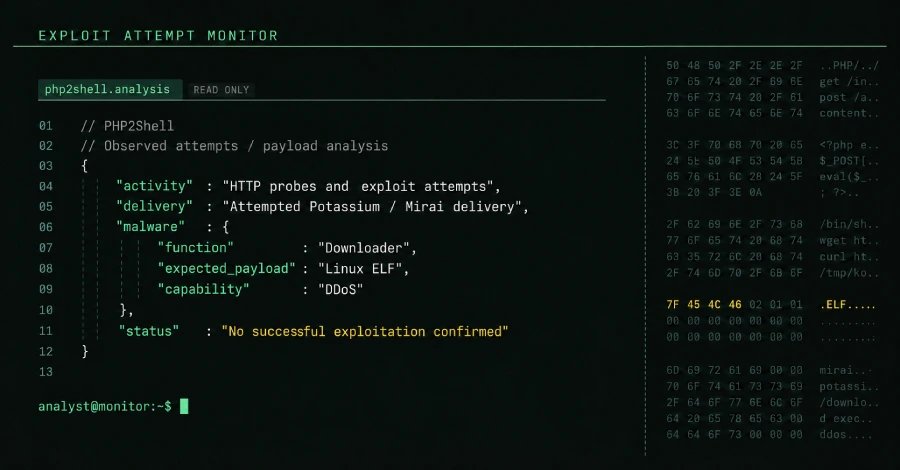
- Critical PHP2Shell flaws (CVE-2026-109618/109619) enable unauthenticated remote code execution; fixes are available for PHP 8.2–8.5.
- Exploitation attempts are widespread, but none have been confirmed successful—reliable attacks appear harder than basic scanning and proof-of-concept attempts suggest.
- Attackers tried to use the flaws to deploy Potassium, a Mirai variant built for DDoS attacks; reported attempts failed.
- Exposure remains substantial: millions of PHP services may be vulnerable, including sites on unsupported versions. Upgrade to a patched PHP release or apply a vendor backport.
PHP2Shell Exploit Attempts Hit Millions as Attackers Try to Deploy Mirai Malware
Millions of probes, but no confirmed break-ins
Attackers have sent millions of requests aimed at two newly disclosed PHP flaws. The flaws, tracked as CVE-2026-109618 and CVE-2026-109619, could let someone run commands on a vulnerable web server without logging in.
The attacks seek to install Potassium, a variant of Mirai malware. Once installed, the malware can turn compromised devices into a botnet—a group of systems that attackers control together. Potassium can use that network to flood websites with traffic and disrupt access.
However, security monitors have not confirmed successful remote break-ins from the observed campaigns. Many attempts appear to involve scanning websites or testing basic exploit code. Researchers say a reliable attack remains difficult, although separate testing has shown that attackers can overcome some built-in defenses under certain conditions.
Updates remain the practical defense
PHP maintainers have released fixes in versions 8.5.12, 8.4.27, 8.3.36, and 8.2.35. Organizations should update to a fixed version. Those running older, unsupported releases should move to a supported branch or apply a security fix from their software provider.
The risk could last because PHP runs millions of websites and online services. Older software may remain exposed even after newer versions receive patches. As a result, website owners need to check not only their applications but also the PHP versions that power them.
For everyday users, the threat is a reminder that a flaw in widely used web software can affect services people rely on, from shopping sites to public information pages. Prompt updates can reduce that risk, even as attackers continue to test which systems they can reach.
Continue Your Tech Journey
Stay informed on the revolutionary breakthroughs in Quantum Computing research.
Stay inspired by the vast knowledge available on Wikipedia.
CyberAttacks-V1
