
Close Menu
  • Home
  • Cybercrime and Ransomware
  • Emerging Tech
  • Threat Intelligence
  • Expert Insights
  • Careers and Learning
  • Compliance

Subscribe to Updates

Subscribe to our newsletter and never miss our latest news

Subscribe my Newsletter for New Posts & tips Let's stay updated!

What's Hot

Future-Proof Your Defense: The Need for Long-Term Planning in Physical AI Security

June 13, 2026

Transform Specs into Agent Evals with ASSERT

June 12, 2026

FBI Cracks Massive China-Based Cybercrime Ring, $1.9B Lost

June 12, 2026
Facebook X (Twitter) Instagram
The CISO Brief
  • Home
  • Cybercrime and Ransomware
  • Emerging Tech
  • Threat Intelligence
  • Expert Insights
  • Careers and Learning
  • Compliance
Home » Passkey Promise Shattered: Major Vulnerability Revealed at DEF CON 33
Cybercrime and Ransomware

Passkey Promise Shattered: Major Vulnerability Revealed at DEF CON 33

Staff WriterBy Staff WriterAugust 28, 2025No Comments4 Mins Read3 Views
Facebook Twitter Pinterest LinkedIn Tumblr Email
Share
Facebook Twitter LinkedIn Pinterest WhatsApp Email

Top Highlights

  1. Passkeys, adopting cryptographic keys for passwordless login, are trusted but vulnerable, with researchers exposing a major security flaw that allows attackers to forge their registration and bypass biometrics via malicious browser scripts and extensions.
  2. The security design assumes a "honest" browser; however, malicious extensions can intercept passkey workflows, rendering account access and re-registration susceptible without visible indicators or signals to users.
  3. Traditional security tools like EDR and SASE/SSE lack visibility within browsers, making it difficult to detect or prevent passkey exploitation, highlighting the need for browser-specific security solutions.
  4. With over 80% of enterprise data stored in SaaS platforms, securing browsers with specialized tools like SquareX’s Browser Detection and Response is essential to safeguard passkey use and prevent browser-based attacks.

Problem Explained

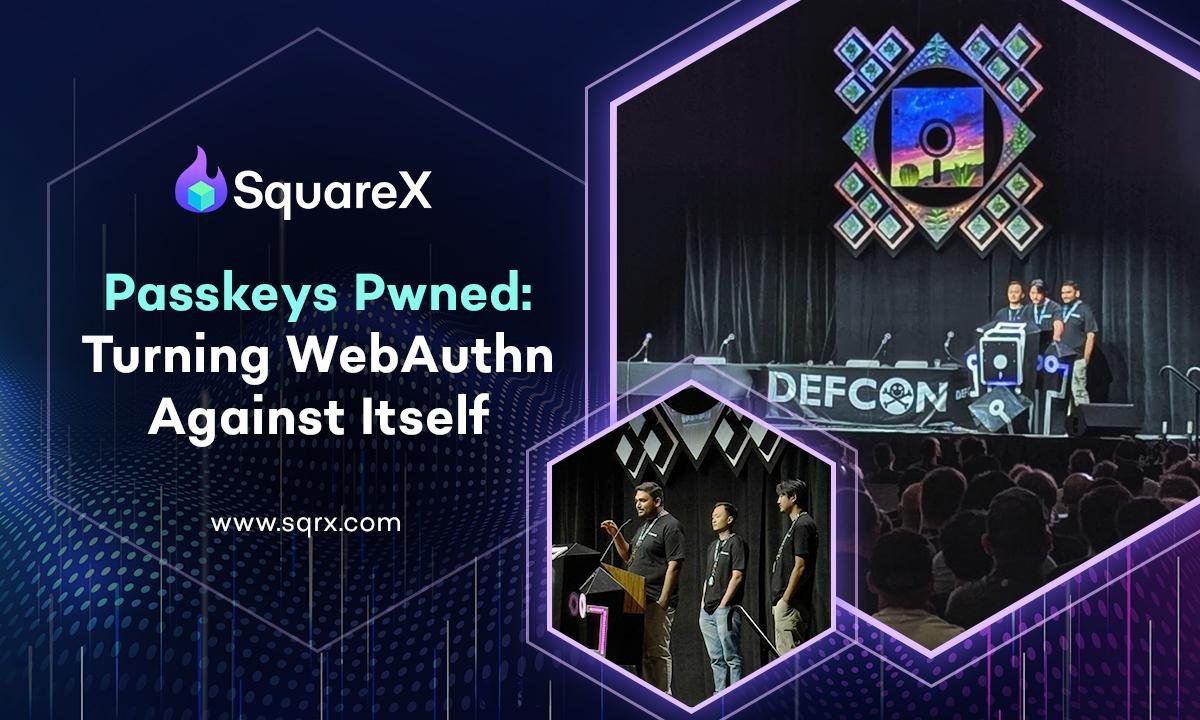
On August 28th, 2025, in Palo Alto, California, researchers from SquareX revealed a significant vulnerability in the emerging passkey authentication system at DEF CON 33. Despite being heralded as a more secure, passwordless alternative that leverages cryptographic key pairs—where private keys are stored locally on devices and only the public key resides on servers—this system has critical flaws. The researchers demonstrated that malicious scripts and browser extensions could intercept and manipulate the passkey registration and login processes, effectively allowing attackers to forge authentication, access sensitive accounts—including banking and enterprise SaaS platforms—and even cause legitimate passkey logins to fail, prompting re-registration under attacker-controlled environments. This weakness arises because passkeys depend heavily on the browser’s honesty; all communications occur through the browser, which can be manipulated without visual cues or detectable signals, leaving traditional security tools ill-equipped to detect such exploits. SquareX’s findings underscore the urgent need for specialized browser security measures—like their Browser Detection and Response solution—to prevent these vulnerabilities from undermining both consumer and enterprise security infrastructures, especially as organizations increasingly rely on passkeys for safeguarding critical data stored within SaaS applications.

Potential Risks

In August 2025, cybersecurity experts revealed a critical vulnerability in passkey-based authentication, a system designed to replace traditional passwords with cryptographic key pairs aimed at bolstering security. Despite its promise to eliminate common password-related risks, researchers demonstrated that malicious browser extensions and scripts can intercept and forge passkey registrations and authentications, effectively bypassing biometric or hardware protections. This browser-centric attack vector compromises not only consumer accounts but also high-stakes enterprise and banking systems, as conventional security tools lack the visibility to detect such sophisticated exploits within the browser environment. As passkeys rapidly become the standard for securing over 15 billion accounts—especially within SaaS platforms where most data resides—the threat underscores the urgent need for specialized browser-level security solutions, such as SquareX’s Browser Detection and Response, to prevent hijacking, unauthorized access, and data breaches driven by browser-based manipulation.

Possible Next Steps

Timely remediation in response to the "Breaking the Passkey Promise: SquareX Discloses Major Passkey Vulnerability at DEF CON 33" is crucial to prevent widespread exploitation, protect sensitive user data, and maintain trust in digital security systems.

Mitigation & Remediation Steps

  • Immediate Patch Deployment: Develop and distribute security patches to address the vulnerability promptly.
  • User Notification: Inform affected users about potential risks and recommend security precautions.
  • Credential Reset: Enforce password or passkey resets for impacted accounts to prevent unauthorized access.
  • Security Audit: Conduct comprehensive vulnerability assessments to identify and address similar issues.
  • Enhanced Monitoring: Implement real-time monitoring to detect suspicious activity referencing the vulnerability.
  • Access Restrictions: Limit or temporarily disable affected authentication methods until patched.
  • Transparency & Communication: Maintain open communication channels with stakeholders regarding progress and updates.
  • Future Prevention: Integrate rigorous security practices, such as code reviews and penetration testing, into development cycles.

Advance Your Cyber Knowledge

Discover cutting-edge developments in Emerging Tech and industry Insights.

Learn more about global cybersecurity standards through the NIST Cybersecurity Framework.

Disclaimer: The information provided may not always be accurate or up to date. Please do your own research, as the cybersecurity landscape evolves rapidly. Intended for secondary references purposes only.

Cyberattacks-V1

CISO Update Cybersecurity MX1
Share. Facebook Twitter Pinterest LinkedIn Tumblr Email
Previous ArticleUnlocking Security: Discover Our PKI Assessment Services!
Next Article Salt Typhoon Breaches 600 Organizations Using Critical Flaws in Cisco, Ivanti, and Palo Alto
Avatar photo
Staff Writer
  • Website

John Marcelli is a staff writer for the CISO Brief, with a passion for exploring and writing about the ever-evolving world of technology. From emerging trends to in-depth reviews of the latest gadgets, John stays at the forefront of innovation, delivering engaging content that informs and inspires readers. When he's not writing, he enjoys experimenting with new tech tools and diving into the digital landscape.

Related Posts

Transform Specs into Agent Evals with ASSERT

June 12, 2026

FBI Cracks Massive China-Based Cybercrime Ring, $1.9B Lost

June 12, 2026

Malicious NPM Campaign Steals SSH Keys, API Tokens, Cloud Credentials & Wallet Secrets

June 12, 2026

Comments are closed.

Latest Posts

FBI Cracks Massive China-Based Cybercrime Ring, $1.9B Lost

June 12, 2026

Malicious NPM Campaign Steals SSH Keys, API Tokens, Cloud Credentials & Wallet Secrets

June 12, 2026

Conti Ransomware Member Faces 20 Years After Guilty Plea

June 12, 2026

Fancy Bear Exploits EdgeRouters and Cloud Services for Stealth Cyberattacks

June 12, 2026
Don't Miss

Transform Specs into Agent Evals with ASSERT

By Staff WriterJune 12, 2026

ASSERT transforms natural-language behavioral specifications into detailed, executable evaluation pipelines by automatically generating test cases,…

FBI Cracks Massive China-Based Cybercrime Ring, $1.9B Lost

June 12, 2026

Malicious NPM Campaign Steals SSH Keys, API Tokens, Cloud Credentials & Wallet Secrets

June 12, 2026

Subscribe to Updates

Subscribe to our newsletter and never miss our latest news

Subscribe my Newsletter for New Posts & tips Let's stay updated!

Recent Posts

  • Future-Proof Your Defense: The Need for Long-Term Planning in Physical AI Security
  • Transform Specs into Agent Evals with ASSERT
  • FBI Cracks Massive China-Based Cybercrime Ring, $1.9B Lost
  • Malicious NPM Campaign Steals SSH Keys, API Tokens, Cloud Credentials & Wallet Secrets
  • Conti Ransomware Member Faces 20 Years After Guilty Plea
About Us
About Us

Welcome to The CISO Brief, your trusted source for the latest news, expert insights, and developments in the cybersecurity world.

In today’s rapidly evolving digital landscape, staying informed about cyber threats, innovations, and industry trends is critical for professionals and organizations alike. At The CISO Brief, we are committed to providing timely, accurate, and insightful content that helps security leaders navigate the complexities of cybersecurity.

Facebook X (Twitter) Pinterest YouTube WhatsApp
Our Picks

Future-Proof Your Defense: The Need for Long-Term Planning in Physical AI Security

June 13, 2026

Transform Specs into Agent Evals with ASSERT

June 12, 2026

FBI Cracks Massive China-Based Cybercrime Ring, $1.9B Lost

June 12, 2026
Most Popular

Protecting MCP Security: Defeating Prompt Injection & Tool Poisoning

January 30, 202633 Views

Unlock the Power of Free WormGPT: Harnessing DeepSeek, Gemini, and Kimi-K2 AI Models

November 27, 202530 Views

The New Face of DDoS is Impacted by AI

August 4, 202528 Views

Archives

  • June 2026
  • May 2026
  • April 2026
  • March 2026
  • February 2026
  • January 2026
  • December 2025
  • November 2025
  • October 2025
  • September 2025
  • August 2025
  • July 2025
  • June 2025

Categories

  • Compliance
  • Cyber Updates
  • Cybercrime and Ransomware
  • Editor's pick
  • Emerging Tech
  • Events
  • Featured
  • Insights
  • Most Read
  • Threat Intelligence
  • Uncategorized
© 2026 thecisobrief. Designed by thecisobrief.
  • Home
  • About Us
  • Advertise with Us
  • Contact Us
  • DMCA
  • Privacy Policy
  • Terms & Conditions

Type above and press Enter to search. Press Esc to cancel.