

Fast Facts
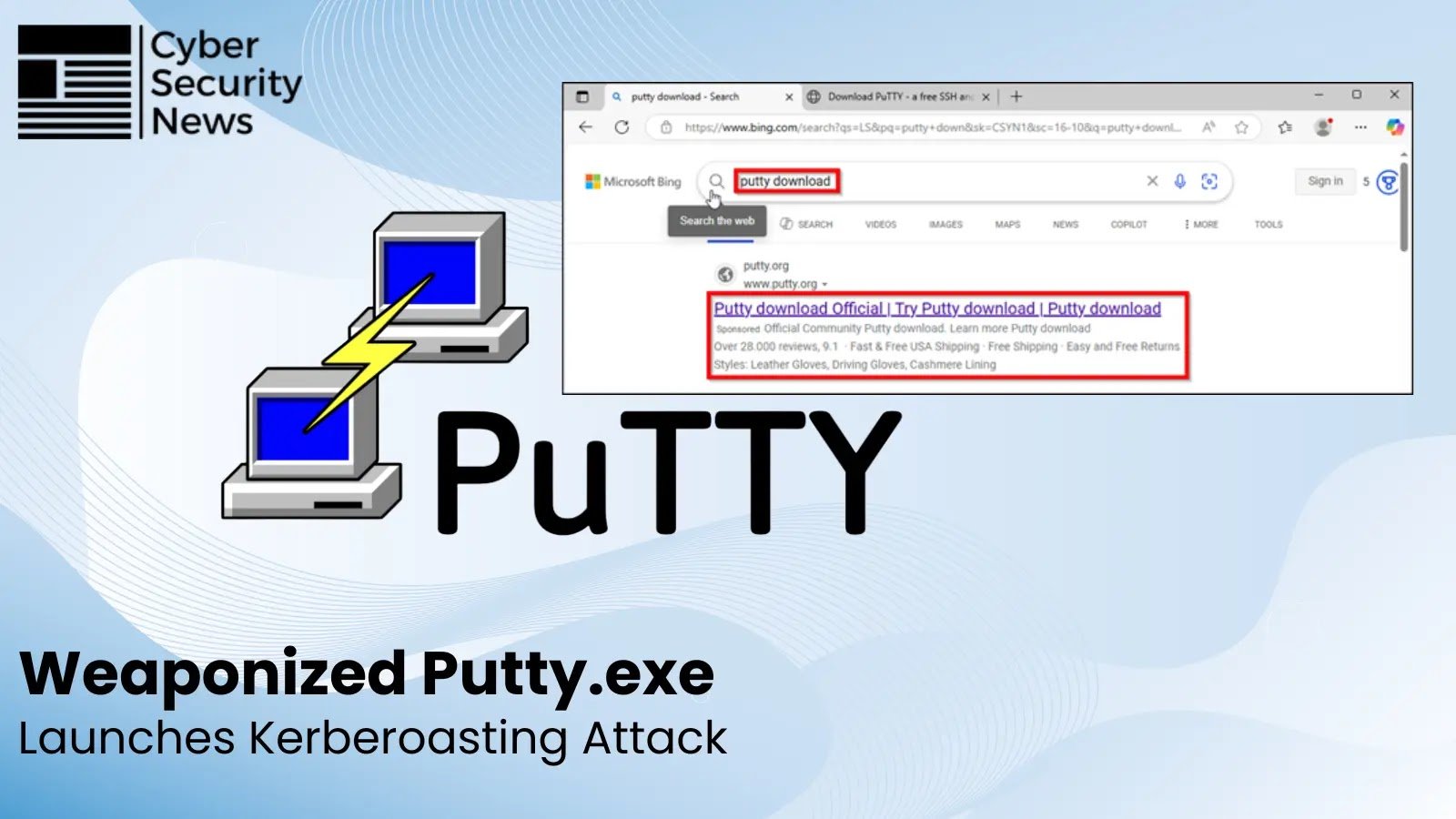
- A malvertising campaign on Microsoft’s search platform delivered a weaponized version of PuTTY, which established persistence, facilitated hands-on keyboard control, and conducted Kerberoasting to target Active Directory service accounts.
- The malicious PuTTY, signed by “NEW VISION MARKETING LLC,” was detected through high-risk alerts, with evidence of outbound malicious traffic, DLL creation, scheduled tasks, and activity aligned with Oyster/Broomstick backdoor tactics.
- The campaign utilized typosquatted domains and compromised WordPress sites to deliver trojanized installers, employing several code-signing certificates and varying domain infrastructure to evade detection.
- Key indicators like malicious domains, hashes, IPs, and scheduled tasks are consolidated for blocking, with security recommendations emphasizing domain blocking, credential rotation, enforced Kerberos encryption, detection development, and continuous threat hunting.
Problem Explained
A sophisticated malvertising campaign exploited sponsored search results on Microsoft’s platform to distribute weaponized versions of PuTTY, a popular remote access tool. This campaign used typosquatting domains such as puttyy.org and puttysystems.com to deliver trojanized installers that embedded malicious code, notably a backdoor known as Oyster/Broomstick. Once installed, the malware established persistence by creating scheduled tasks, such as “Security Updater,” which repeatedly executed malicious DLLs, notably twain_96.dll and green.dll, to facilitate command and control activities. These DLLs enabled remote operators to conduct reconnaissance and exploit Kerberos protocol weaknesses through in-memory Kerberoasting, extracting service account credentials for lateral movement and privilege escalation within Active Directory environments. The activities, identified and reported by LevelBlue’s MDR SOC, highlighted a broad spectrum of indicators of compromise, including suspicious domain registrations, code-signing certificates, and outbound traffic to malicious infrastructure, which align with recent trends in targeted cyber espionage and credential theft. The investigation emphasizes the importance of blocking malicious domains, enforcing stricter security policies on Kerberos, rotational credential management, and enhanced detection for in-memory Kerberoasting techniques to mitigate similar threats in the future.
Risks Involved
A recent malvertising campaign exploited sponsored search results on Microsoft’s platform to distribute trojanized PuTTY installers, utilizing typosquatted domains and SEO poisoning techniques to deliver malicious payloads. Once installed, the malware established persistence through scheduled tasks and DLL injections, facilitating remote control and reconnaissance activities. It executed sophisticated Kerberoasting in-memory attacks, requesting and extracting weak Kerberos tickets for privilege escalation and lateral movement within Active Directory environments. Indicators of compromise, including malicious domains, file hashes, and abusive code-signing certificates, have been identified; these should be integrated into detection and blocking measures. This campaign underscores the high risks posed by malicious advertising and SEO manipulation to enterprise security, emphasizing the need for domain filtering, credential rotation, vigilant endpoint monitoring, and user awareness to prevent credential theft, system compromise, and potential ransomware deployment.
Fix & Mitigation
Addressing malicious Bing Ads deploying weaponized PuTTY to exploit Kerberos and attack Active Directory services is vital for maintaining cybersecurity integrity. Timely remediation is essential to prevent data breaches, service disruptions, and long-term damage to organizational reputation and operational stability.
Mitigation Strategies
- Implement strict ad content review protocols
- Deploy real-time web filtering tools
- Enforce strong endpoint security measures
- Conduct regular security audits and vulnerability scans
- Educate staff on social engineering and phishing risks
Remediation Steps
- Block malicious domains and IP addresses
- Isolate compromised systems from the network
- Reset affected user credentials and Kerberos tickets
- Apply patches and security updates to vulnerable systems
- Perform forensic analysis to understand attack vectors
- Notify relevant authorities and stakeholders about the incident
Explore More Security Insights
Discover cutting-edge developments in Emerging Tech and industry Insights.
Understand foundational security frameworks via NIST CSF on Wikipedia.
Disclaimer: The information provided may not always be accurate or up to date. Please do your own research, as the cybersecurity landscape evolves rapidly. Intended for secondary references purposes only.
Cyberattacks-V1
