
Close Menu
  • Home
  • Cybercrime and Ransomware
  • Emerging Tech
  • Threat Intelligence
  • Expert Insights
  • Careers and Learning
  • Compliance

Subscribe to Updates

Subscribe to our newsletter and never miss our latest news

Subscribe my Newsletter for New Posts & tips Let's stay updated!

What's Hot

Google Patches Critical Android Zero-Day Exploit

June 8, 2026

Critical Linux Kernel Flaw Under Fire in Widespread Attacks

June 7, 2026

Revolutionizing Security: Infoblox IQ Empowers AI-Driven Operations

June 7, 2026
Facebook X (Twitter) Instagram
The CISO Brief
  • Home
  • Cybercrime and Ransomware
  • Emerging Tech
  • Threat Intelligence
  • Expert Insights
  • Careers and Learning
  • Compliance
Home » Weaponized PuTTY Hacks Kerberos to Target Active Directory via Bing Ads
Cybercrime and Ransomware

Weaponized PuTTY Hacks Kerberos to Target Active Directory via Bing Ads

Staff WriterBy Staff WriterAugust 26, 2025No Comments4 Mins Read4 Views
Facebook Twitter Pinterest LinkedIn Tumblr Email
Share
Facebook Twitter LinkedIn Pinterest WhatsApp Email

Fast Facts

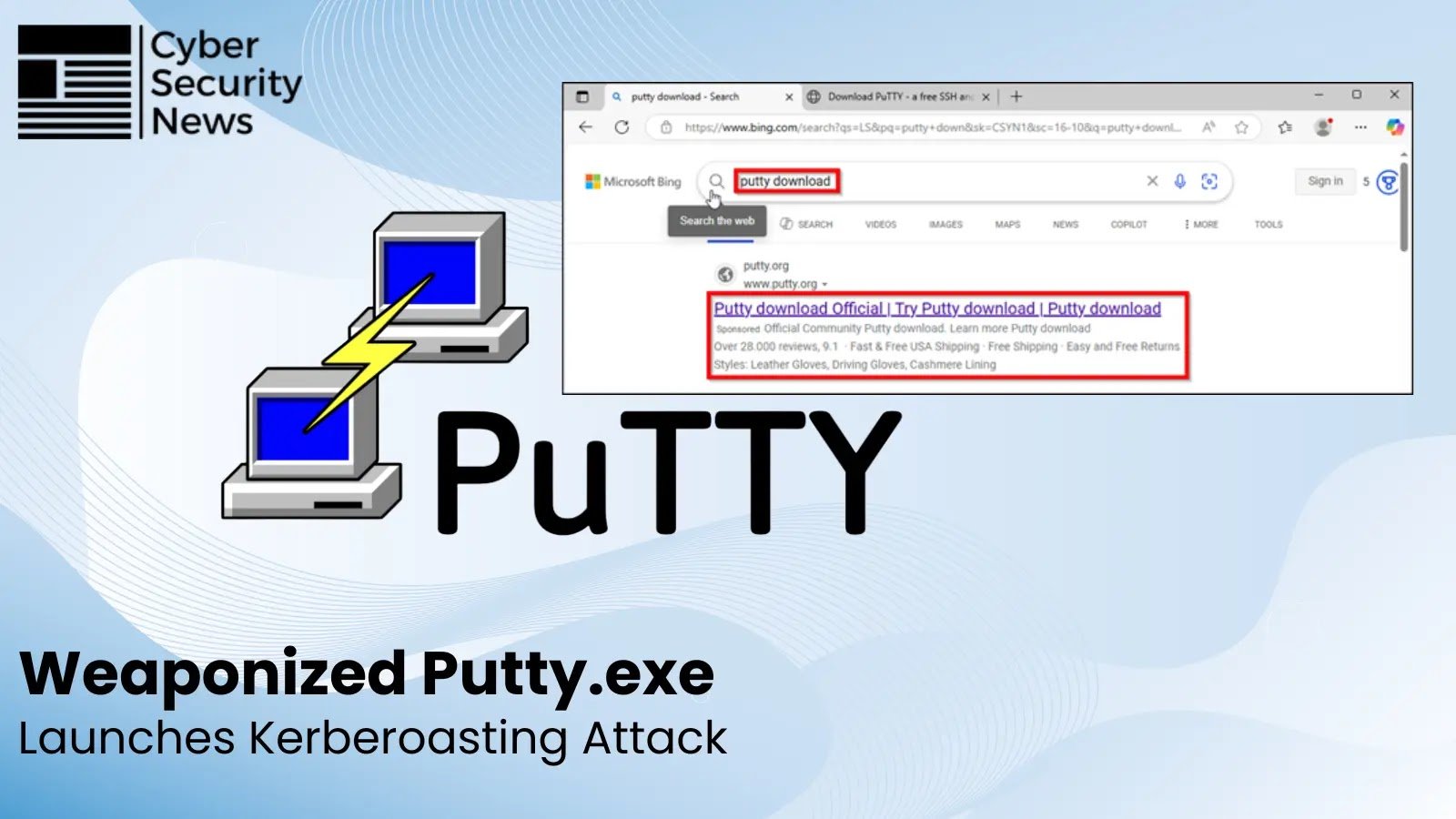
  1. A malvertising campaign on Microsoft’s search platform delivered a weaponized version of PuTTY, which established persistence, facilitated hands-on keyboard control, and conducted Kerberoasting to target Active Directory service accounts.
  2. The malicious PuTTY, signed by “NEW VISION MARKETING LLC,” was detected through high-risk alerts, with evidence of outbound malicious traffic, DLL creation, scheduled tasks, and activity aligned with Oyster/Broomstick backdoor tactics.
  3. The campaign utilized typosquatted domains and compromised WordPress sites to deliver trojanized installers, employing several code-signing certificates and varying domain infrastructure to evade detection.
  4. Key indicators like malicious domains, hashes, IPs, and scheduled tasks are consolidated for blocking, with security recommendations emphasizing domain blocking, credential rotation, enforced Kerberos encryption, detection development, and continuous threat hunting.

Problem Explained

A sophisticated malvertising campaign exploited sponsored search results on Microsoft’s platform to distribute weaponized versions of PuTTY, a popular remote access tool. This campaign used typosquatting domains such as puttyy.org and puttysystems.com to deliver trojanized installers that embedded malicious code, notably a backdoor known as Oyster/Broomstick. Once installed, the malware established persistence by creating scheduled tasks, such as “Security Updater,” which repeatedly executed malicious DLLs, notably twain_96.dll and green.dll, to facilitate command and control activities. These DLLs enabled remote operators to conduct reconnaissance and exploit Kerberos protocol weaknesses through in-memory Kerberoasting, extracting service account credentials for lateral movement and privilege escalation within Active Directory environments. The activities, identified and reported by LevelBlue’s MDR SOC, highlighted a broad spectrum of indicators of compromise, including suspicious domain registrations, code-signing certificates, and outbound traffic to malicious infrastructure, which align with recent trends in targeted cyber espionage and credential theft. The investigation emphasizes the importance of blocking malicious domains, enforcing stricter security policies on Kerberos, rotational credential management, and enhanced detection for in-memory Kerberoasting techniques to mitigate similar threats in the future.

Risks Involved

A recent malvertising campaign exploited sponsored search results on Microsoft’s platform to distribute trojanized PuTTY installers, utilizing typosquatted domains and SEO poisoning techniques to deliver malicious payloads. Once installed, the malware established persistence through scheduled tasks and DLL injections, facilitating remote control and reconnaissance activities. It executed sophisticated Kerberoasting in-memory attacks, requesting and extracting weak Kerberos tickets for privilege escalation and lateral movement within Active Directory environments. Indicators of compromise, including malicious domains, file hashes, and abusive code-signing certificates, have been identified; these should be integrated into detection and blocking measures. This campaign underscores the high risks posed by malicious advertising and SEO manipulation to enterprise security, emphasizing the need for domain filtering, credential rotation, vigilant endpoint monitoring, and user awareness to prevent credential theft, system compromise, and potential ransomware deployment.

Fix & Mitigation

Addressing malicious Bing Ads deploying weaponized PuTTY to exploit Kerberos and attack Active Directory services is vital for maintaining cybersecurity integrity. Timely remediation is essential to prevent data breaches, service disruptions, and long-term damage to organizational reputation and operational stability.

Mitigation Strategies

  • Implement strict ad content review protocols
  • Deploy real-time web filtering tools
  • Enforce strong endpoint security measures
  • Conduct regular security audits and vulnerability scans
  • Educate staff on social engineering and phishing risks

Remediation Steps

  • Block malicious domains and IP addresses
  • Isolate compromised systems from the network
  • Reset affected user credentials and Kerberos tickets
  • Apply patches and security updates to vulnerable systems
  • Perform forensic analysis to understand attack vectors
  • Notify relevant authorities and stakeholders about the incident

Explore More Security Insights

Discover cutting-edge developments in Emerging Tech and industry Insights.

Understand foundational security frameworks via NIST CSF on Wikipedia.

Disclaimer: The information provided may not always be accurate or up to date. Please do your own research, as the cybersecurity landscape evolves rapidly. Intended for secondary references purposes only.

Cyberattacks-V1

CISO Update Cybersecurity MX1
Share. Facebook Twitter Pinterest LinkedIn Tumblr Email
Previous ArticleCyberTech Daily: Key Insights & News You Need
Next Article Android Trojan Escalates with Ransomware Overlays and 107 Remote Commands
Avatar photo
Staff Writer
  • Website

John Marcelli is a staff writer for the CISO Brief, with a passion for exploring and writing about the ever-evolving world of technology. From emerging trends to in-depth reviews of the latest gadgets, John stays at the forefront of innovation, delivering engaging content that informs and inspires readers. When he's not writing, he enjoys experimenting with new tech tools and diving into the digital landscape.

Related Posts

Critical Linux Kernel Flaw Under Fire in Widespread Attacks

June 7, 2026

Choosing the Right Vulnerability Management Solution

June 6, 2026

Time-to-Revoke: The Critical Metric CISOs Must Track in the AI Era

June 6, 2026

Comments are closed.

Latest Posts

Critical Linux Kernel Flaw Under Fire in Widespread Attacks

June 7, 2026

Urgent Alert: SolarWinds Serv-U Vulnerability Exploited in Attacks

June 6, 2026

Cryptominer Attack Hits Windows Delivery Pipeline

June 5, 2026

Chinese APT VerdantBamboo Exploits BRICKSTORM Malware to Breach Firewalls and Devices

June 5, 2026
Don't Miss

Critical Linux Kernel Flaw Under Fire in Widespread Attacks

By Staff WriterJune 7, 2026

Top Highlights The U.S. CISA has added CVE-2022-0492, a critical Linux kernel flaw related to…

Choosing the Right Vulnerability Management Solution

June 6, 2026

Time-to-Revoke: The Critical Metric CISOs Must Track in the AI Era

June 6, 2026

Subscribe to Updates

Subscribe to our newsletter and never miss our latest news

Subscribe my Newsletter for New Posts & tips Let's stay updated!

Recent Posts

  • Google Patches Critical Android Zero-Day Exploit
  • Critical Linux Kernel Flaw Under Fire in Widespread Attacks
  • Revolutionizing Security: Infoblox IQ Empowers AI-Driven Operations
  • Choosing the Right Vulnerability Management Solution
  • Time-to-Revoke: The Critical Metric CISOs Must Track in the AI Era
About Us
About Us

Welcome to The CISO Brief, your trusted source for the latest news, expert insights, and developments in the cybersecurity world.

In today’s rapidly evolving digital landscape, staying informed about cyber threats, innovations, and industry trends is critical for professionals and organizations alike. At The CISO Brief, we are committed to providing timely, accurate, and insightful content that helps security leaders navigate the complexities of cybersecurity.

Facebook X (Twitter) Pinterest YouTube WhatsApp
Our Picks

Google Patches Critical Android Zero-Day Exploit

June 8, 2026

Critical Linux Kernel Flaw Under Fire in Widespread Attacks

June 7, 2026

Revolutionizing Security: Infoblox IQ Empowers AI-Driven Operations

June 7, 2026
Most Popular

Protecting MCP Security: Defeating Prompt Injection & Tool Poisoning

January 30, 202633 Views

Unlock the Power of Free WormGPT: Harnessing DeepSeek, Gemini, and Kimi-K2 AI Models

November 27, 202530 Views

The New Face of DDoS is Impacted by AI

August 4, 202528 Views

Archives

  • June 2026
  • May 2026
  • April 2026
  • March 2026
  • February 2026
  • January 2026
  • December 2025
  • November 2025
  • October 2025
  • September 2025
  • August 2025
  • July 2025
  • June 2025

Categories

  • Compliance
  • Cyber Updates
  • Cybercrime and Ransomware
  • Editor's pick
  • Emerging Tech
  • Events
  • Featured
  • Insights
  • Most Read
  • Threat Intelligence
  • Uncategorized
© 2026 thecisobrief. Designed by thecisobrief.
  • Home
  • About Us
  • Advertise with Us
  • Contact Us
  • DMCA
  • Privacy Policy
  • Terms & Conditions

Type above and press Enter to search. Press Esc to cancel.