

Essential Insights
- Storm-0501, a hacking group active since 2021, has evolved from on-premises to cloud-based attacks, focusing on data exfiltration, destruction, and extortion in cloud environments using native capabilities instead of traditional malware.
- Their tactics include exploiting stolen credentials, privilege escalation, lateral movement, and advanced techniques like DCSync attacks to compromise Active Directory and cloud tenants, often targeting unmanaged devices and security gaps.
- The group exfiltrates data, then destroys backups and resources before executing extortion schemes—demanding ransom via platforms like Microsoft Teams—often after resetting admin passwords and creating backdoors.
- Microsoft has responded with security updates, including measures to prevent abuse of Directory Synchronization Accounts and support for Modern Authentication, aiming to mitigate Storm-0501’s tactics and safeguard cloud environments.
Problem Explained
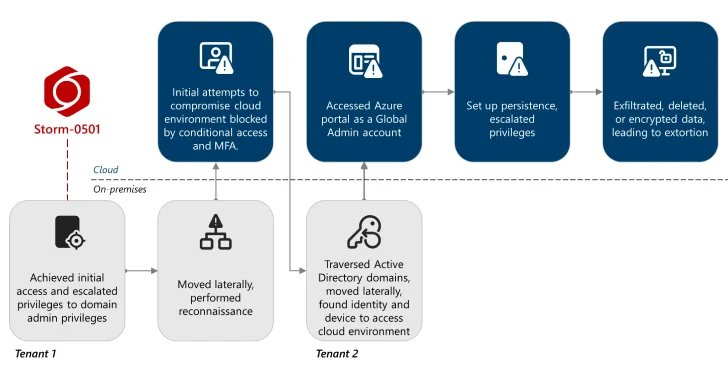
The story details a sophisticated cyberattack carried out by the threat actor known as Storm-0501, which has shifted its tactics from traditional ransomware to targeting cloud environments using advanced exfiltration and extortion methods. Since 2021, this group has evolved into a ransomware-as-a-service operation, leveraging cloud-native tools to quickly steal significant amounts of data, destroy backups and security controls, and demand ransoms—all without deploying conventional malware. In a recent attack on a large multinational enterprise, Storm-0501 exploited vulnerabilities within the organization’s hybrid cloud infrastructure by gaining initial access via stolen credentials, escalating privileges through Active Directory manipulation, and moving laterally across the network using specialized tools like Evil-WinRM and DCSync attacks. They compromised a high-level admin account with no multi-factor authentication, used it to create backdoors, and ultimately exfiltrated sensitive data before deleting it to hinder recovery efforts. Following this, they demanded ransom payments via Microsoft Teams. Microsoft has responded by updating security measures, including safeguards in Microsoft Entra ID and Entra Connect, to prevent similar breaches in the future, emphasizing how adaptable and persistent these threat actors have become in exploiting cloud environments.
Risks Involved
Cyber risks posed by threat groups like Storm-0501 highlight a disturbing evolution in cyberattacks, where malicious actors leverage cloud-native capabilities to conduct sophisticated, multi-stage operations including data exfiltration, destruction, and extortion without relying solely on traditional malware. By exploiting vulnerabilities in hybrid cloud environments, manipulating unmanaged devices, and abusing privileged accounts—such as compromising Global Admin identities through techniques like DCSync—attackers can traverse interconnected systems, escalate privileges, and gain persistent access across on-premises and cloud segments. Their tactics often involve stealthy reconnaissance, lateral movement, deactivation of backups, and resource deletion to impede recovery efforts, ultimately enabling large-scale data breaches and extortion campaigns. This evolving threat landscape underscores the critical need for enhanced security protocols, rigorous credential management, multi-factor authentication, and proactive monitoring to mitigate the profound impacts of such cyber risks on organizational integrity, operational continuity, and data privacy.
Fix & Mitigation
Rapid response is critical when facing threats like Storm-0501 exploits because swift action can prevent extensive data loss and mitigate the potential damage from hybrid cloud attacks. The speed of remediation can mean the difference between containment and widespread compromise.
Mitigation Steps
- Immediate Isolation: Disconnect affected systems from the network to prevent further exploitation.
- Access Revocation: Reset compromised credentials and revoke any suspicious permissions.
- Patch Deployment: Apply the latest security updates and patches to vulnerable Entra ID components.
- Monitoring & Detection: Increase monitoring for unusual activities and implement intrusion detection systems.
- Incident Analysis: Conduct a thorough investigation to understand the attack vector and scope.
- Backup Restoration: Restore data from secure backups if data exfiltration or deletion has occurred.
- User Training: Educate users on security best practices and phishing awareness to prevent credential compromise.
- Enhanced Security Controls: Implement multi-factor authentication, conditional access policies, and least privilege principles.
- Collaborate & Report: Engage with security vendors and report the incident to relevant authorities for coordinated response.
Continue Your Cyber Journey
Stay informed on the latest Threat Intelligence and Cyberattacks.
Access world-class cyber research and guidance from IEEE.
Disclaimer: The information provided may not always be accurate or up to date. Please do your own research, as the cybersecurity landscape evolves rapidly. Intended for secondary references purposes only.
Cyberattacks-V1
