
Close Menu
  • Home
  • Cybercrime and Ransomware
  • Emerging Tech
  • Threat Intelligence
  • Expert Insights
  • Careers and Learning
  • Compliance

Subscribe to Updates

Subscribe to our newsletter and never miss our latest news

Subscribe my Newsletter for New Posts & tips Let's stay updated!

What's Hot

Cybercriminal phishing tactics: prediction, prioritization, and prevention

June 3, 2026

Singapore Crafts National AI Governance Strategy

June 3, 2026

Secure the Future: Protecting Code, Agents, and Models Throughout Development

June 2, 2026
Facebook X (Twitter) Instagram
The CISO Brief
  • Home
  • Cybercrime and Ransomware
  • Emerging Tech
  • Threat Intelligence
  • Expert Insights
  • Careers and Learning
  • Compliance
Home » AI-Driven Email Attack Tool Fuels Massive Phishing Surge
Cybercrime and Ransomware

AI-Driven Email Attack Tool Fuels Massive Phishing Surge

Staff WriterBy Staff WriterSeptember 9, 2025No Comments4 Mins Read4 Views
Facebook Twitter Pinterest LinkedIn Tumblr Email
Share
Facebook Twitter LinkedIn Pinterest WhatsApp Email

Fast Facts

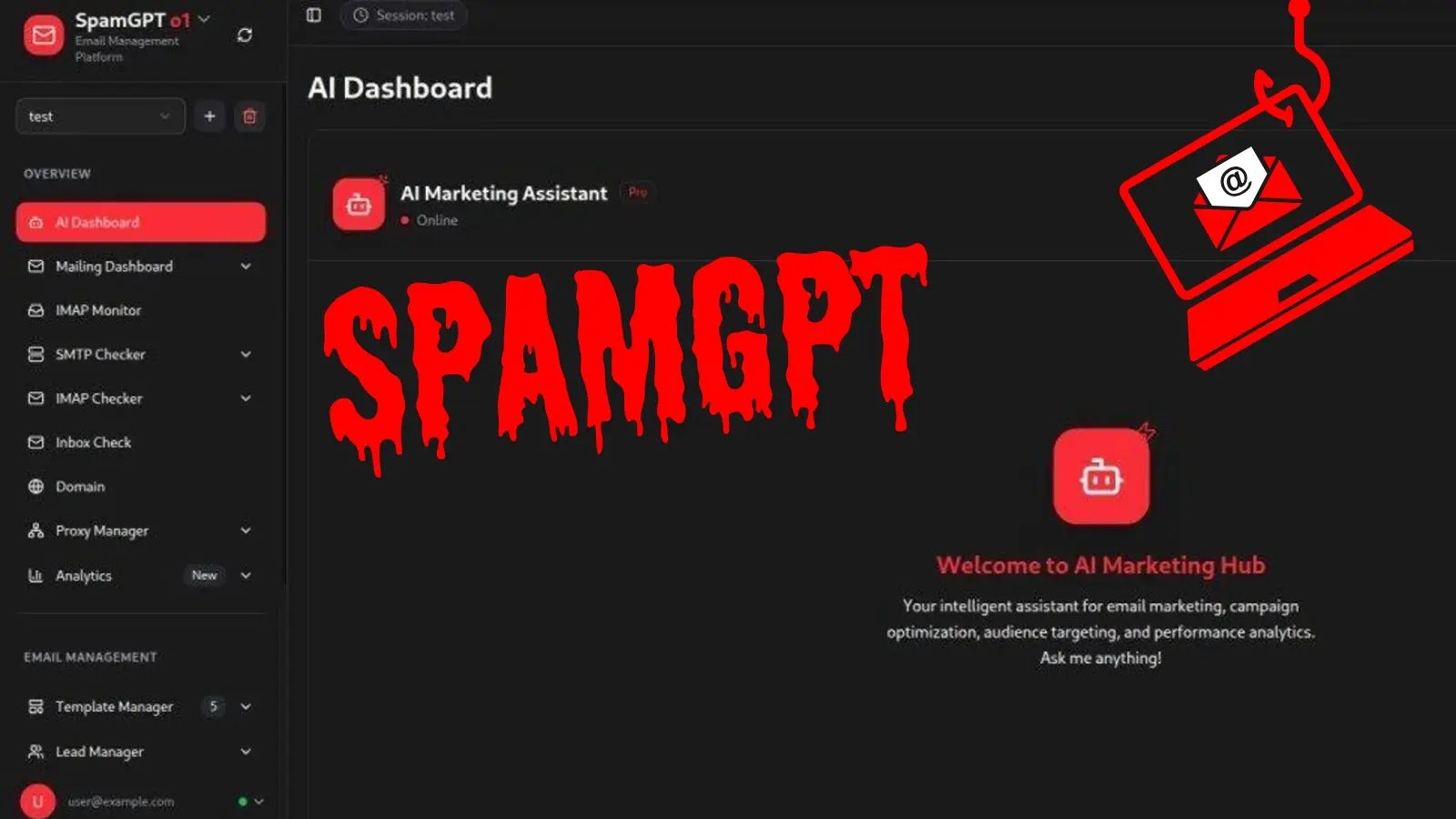
  1. SpamGPT is a dark web "spam-as-a-service" platform that uses AI to automate and enhance large-scale phishing campaigns, lowering technical barriers for cybercriminals.
  2. The platform mimics legitimate marketing tools, offering features like campaign management, email testing, and real-time analytics, with an AI assistant called KaliGPT to generate convincing phishing content.
  3. It facilitates sophisticated spoofing techniques, automates infrastructure management, and includes training on SMTP cracking, enabling even low-skilled actors to execute effective, undetectable attacks.
  4. To combat such threats, organizations must strengthen email authentication protocols (DMARC, SPF, DKIM) and deploy AI-enabled security solutions to identify AI-generated phishing content.

The Core Issue

The story reports on a cutting-edge cybercrime platform called SpamGPT, which is being marketed on the dark web as a “spam-as-a-service” toolkit that dramatically lowers the technical barriers for carrying out large-scale phishing attacks. Created to mimic legitimate marketing software, SpamGPT leverages artificial intelligence, specifically an integrated AI assistant dubbed “KaliGPT,” to generate convincing scam emails, craft engaging subject lines, and provide targeting advice. This platform automates many aspects of cybercrimes—such as setting up mail servers, testing email delivery, and monitoring campaign success—making it accessible even to low-skilled criminals who pay $5,000 for training on “SMTP cracking.” Attackers armed with SpamGPT can bypass standard security checks like SPF and DKIM by spoofing trusted domains and exploiting cloud services like Amazon AWS and SendGrid, greatly increasing the sophistication, scale, and success rate of phishing operations. The report is issued by cybersecurity experts warning organizations about how this automation-driven tool is fueling an alarming escalation in cyber threats, emphasizing the urgent need for reinforced email security protocols and advanced detection measures to combat this new wave of AI-powered cybercrime.

Risks Involved

SpamGPT represents a groundbreaking yet perilous advancement in cybercrime, seamlessly blending artificial intelligence with professional email marketing functionalities to enable scaleable, persuasive, and automated phishing campaigns. Marketed as a “spam-as-a-service” platform on the dark web, it simplifies complex operations—such as crafting convincing scam emails, bypassing security protocols, and managing vast infrastructures—making sophisticated cyberattacks accessible even to low-skilled actors. Its AI assistant, KaliGPT, can generate targeted content and optimize campaigns, while features for spoofing, credential validation, and delivery testing significantly enhance attack effectiveness and evasion. The platform’s automation and deep integration of advanced tools drastically inflate the risk and impact of phishing, threatening organizational security and financial integrity. To combat this evolution, organizations must reinforce email authentication protocols (DMARC, SPF, DKIM) and deploy AI-powered detection solutions capable of identifying AI-generated malicious content, emphasizing the critical need for proactive and adaptive cybersecurity defenses in an era where cybercriminals leverage automation to amplify their reach and sophistication.

Fix & Mitigation

Timely remediation is crucial when facing an AI-powered email attack tool used by hackers to conduct massive phishing campaigns, as swift action can significantly limit damage, protect sensitive information, and restore trust in communication channels.

Detection

  • Implement advanced email filtering and AI-based threat detection systems
  • Monitor network traffic and email logs for unusual patterns
  • Conduct regular security audits and vulnerability assessments

Containment

  • Isolate affected systems and revoke malicious email access
  • Alert users about ongoing phishing threats and provide guidance
  • Disable compromised accounts promptly

Eradication

  • Remove malicious email tools and associated malware from systems
  • Update and patch software vulnerabilities exploited by attackers
  • Change affected credentials and enforce strong authentication measures

Recovery

  • Restore email systems from clean backups
  • Notify stakeholders and comply with reporting regulations
  • Reinforce employee training on phishing awareness

Prevention

  • Deploy multi-factor authentication across systems
  • Conduct ongoing security awareness training
  • Regularly update security protocols and software defenses

Explore More Security Insights

Discover cutting-edge developments in Emerging Tech and industry Insights.

Explore engineering-led approaches to digital security at IEEE Cybersecurity.

Disclaimer: The information provided may not always be accurate or up to date. Please do your own research, as the cybersecurity landscape evolves rapidly. Intended for secondary references purposes only.

Cyberattacks-V1

CISO Update Cybersecurity MX1
Share. Facebook Twitter Pinterest LinkedIn Tumblr Email
Previous ArticleHackers Breach Customer Data in Salesforce
Next Article Winning the Budget Battle: How Top CISOs Secure Funding
Avatar photo
Staff Writer
  • Website

John Marcelli is a staff writer for the CISO Brief, with a passion for exploring and writing about the ever-evolving world of technology. From emerging trends to in-depth reviews of the latest gadgets, John stays at the forefront of innovation, delivering engaging content that informs and inspires readers. When he's not writing, he enjoys experimenting with new tech tools and diving into the digital landscape.

Related Posts

Cybercriminal phishing tactics: prediction, prioritization, and prevention

June 3, 2026

Secure the Future: Protecting Code, Agents, and Models Throughout Development

June 2, 2026

Ransomware novice breaches core operational security protocol

June 2, 2026

Comments are closed.

Latest Posts

Mustang Panda Deploys PlugX RAT via Multi-Stage LNK and PowerShell Attack Chain

June 2, 2026

Anthropic extends Project Glasswing Claude Mythos preview to 150 new organizations

June 2, 2026

Urgent: Two-Year-Old Oracle WebLogic Vulnerability Under Active Attack

June 2, 2026

CISA Warns of PAN-OS Vulnerability Exploited in Attacks

June 2, 2026
Don't Miss

Cybercriminal phishing tactics: prediction, prioritization, and prevention

By Staff WriterJune 3, 2026

Quick Takeaways Phishing remains the leading cyber threat in finance, exploiting human fallibility through increasingly…

Secure the Future: Protecting Code, Agents, and Models Throughout Development

June 2, 2026

Ransomware novice breaches core operational security protocol

June 2, 2026

Subscribe to Updates

Subscribe to our newsletter and never miss our latest news

Subscribe my Newsletter for New Posts & tips Let's stay updated!

Recent Posts

  • Cybercriminal phishing tactics: prediction, prioritization, and prevention
  • Singapore Crafts National AI Governance Strategy
  • Secure the Future: Protecting Code, Agents, and Models Throughout Development
  • Ransomware novice breaches core operational security protocol
  • FBI-Flagged Phishing Kit Kali365 Extends Its Reach
About Us
About Us

Welcome to The CISO Brief, your trusted source for the latest news, expert insights, and developments in the cybersecurity world.

In today’s rapidly evolving digital landscape, staying informed about cyber threats, innovations, and industry trends is critical for professionals and organizations alike. At The CISO Brief, we are committed to providing timely, accurate, and insightful content that helps security leaders navigate the complexities of cybersecurity.

Facebook X (Twitter) Pinterest YouTube WhatsApp
Our Picks

Cybercriminal phishing tactics: prediction, prioritization, and prevention

June 3, 2026

Singapore Crafts National AI Governance Strategy

June 3, 2026

Secure the Future: Protecting Code, Agents, and Models Throughout Development

June 2, 2026
Most Popular

Protecting MCP Security: Defeating Prompt Injection & Tool Poisoning

January 30, 202632 Views

Unlock the Power of Free WormGPT: Harnessing DeepSeek, Gemini, and Kimi-K2 AI Models

November 27, 202530 Views

The New Face of DDoS is Impacted by AI

August 4, 202528 Views

Archives

  • June 2026
  • May 2026
  • April 2026
  • March 2026
  • February 2026
  • January 2026
  • December 2025
  • November 2025
  • October 2025
  • September 2025
  • August 2025
  • July 2025
  • June 2025

Categories

  • Compliance
  • Cyber Updates
  • Cybercrime and Ransomware
  • Editor's pick
  • Emerging Tech
  • Events
  • Featured
  • Insights
  • Most Read
  • Threat Intelligence
  • Uncategorized
© 2026 thecisobrief. Designed by thecisobrief.
  • Home
  • About Us
  • Advertise with Us
  • Contact Us
  • DMCA
  • Privacy Policy
  • Terms & Conditions

Type above and press Enter to search. Press Esc to cancel.