


Summary Points
-
Rising Importance of Non-Human Identities (NHIs): NHIs, including service and machine identities, are rapidly transforming cybersecurity strategies as they become essential to the digital infrastructure, enabling seamless interaction among systems.
-
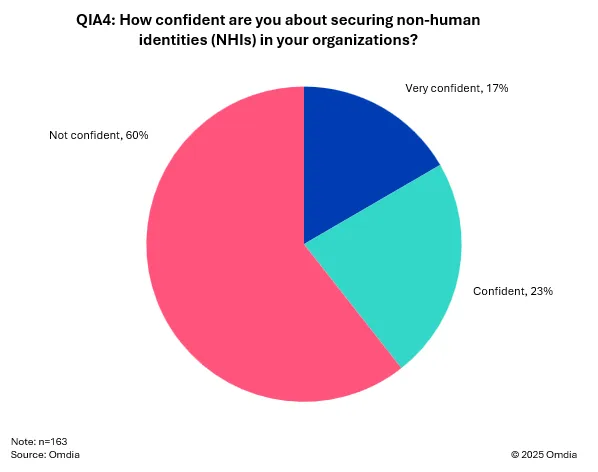
Security Confidence Gap Identified: Approximately 60% of cybersecurity professionals lack confidence in their organization’s ability to secure NHIs, revealing a critical gap in security measures amid their expanding presence.
-
Governance Challenges: Managing NHIs poses unique challenges, such as credential security, visibility, and privilege management, necessitating sophisticated frameworks to prevent unauthorized access and maintain accountability.
-
Urgent Need for Robust Security Frameworks: Organizations must implement comprehensive NHI management strategies, focusing on lifecycle management, access controls, and continuous monitoring to address vulnerabilities and keep pace with rapid technological advancements.
[gptAs a technology journalist, write a short news story divided in two subheadings, at 12th grade reading level about ‘Enterprises Not Confident They Can Secure NHIs’in short sentences using transition words, in an informative and explanatory tone, from the perspective of an insightful Tech News Editor, ensure clarity, consistency, and accessibility. Use concise, factual language and avoid jargon that may confuse readers. Maintain a neutral yet engaging tone to provide balanced perspectives on practicality, possible widespread adoption, and contribution to the human journey. Avoid passive voice. The article should provide relatable insights based on the following information ‘
COMMENTARY
Non-human identities (NHIs) are poised to experience exponential growth and adoption throughout the coming year, fundamentally transforming how organizations approach cybersecurity. These digital entities, which include service accounts, system identities, machine identities, and other forms of automated identities, serve as the backbone of modern digital infrastructure by enabling communication and interaction between applications, services, and automated systems.
The scope of NHIs extends far beyond simple service accounts, encompassing a diverse ecosystem of digital identities that power today’s interconnected technological environment. These critical components include:
Service accounts: Dedicated accounts that sysadmins use to access resources and perform operations.
API keys: Authentication credentials that enable secure communication between different software applications.
Digital certificates: Cryptographic credentials that verify the authenticity and integrity of digital communications.
Access tokens: Temporary credentials that grant specific permissions for limited timeframes.
Automated bots: Programmed entities that perform routine tasks and interactions across systems.
IoT devices and nodes: Systems that communicate on the Internet of Things (IoT) without the need for human intervention.
AI agents: Am emerging category of NHI, agents are a security concern on account of their levels both of system access and autonomy.
The NHI Security Confidence Gap
The management and protection of NHIs presents unique challenges that differ significantly from traditional human identity security. These identities require sophisticated governance frameworks to maintain secure inter-service communication, prevent unauthorized system access, and establish clear audit trails for accountability purposes. Unlike human users, NHIs operate autonomously, often with elevated privileges, and can be difficult to monitor using conventional security tools.
Recent findings from Omdia’s Decision Maker Survey 2025 (see Figure 1) reveal a concerning confidence deficit in the cybersecurity community. Approximately 60% of survey respondents expressed a lack of confidence in their organization’s ability to adequately secure NHIs. This statistic underscores a critical gap between the rapid proliferation of these identities and the security measures implemented to protect them, highlighting the urgent need for enhanced security strategies and solutions.
Figure 1 – Confidence level of securing non-human identities (NHIs) in your organization
The issues and problems with NHIs
Omdia believes that that there are a number of issues and problems that organizations need to address around NHIs, including:
Credential security: Many NHIs use plaintext credentials hardcoded in source repositories, making them easily discoverable by threat actors. Additionally, non-complex passwords make these accounts vulnerable to password-guessing attacks.
Inventory and visibility challenges: Organizations struggle to maintain complete inventories of NHIs across multiple platforms, endpoints, and cloud integrations. This leads to stale, inactive accounts that expand the attack surface and lack clear ownership for remediation activities.
Privilege management: NHIs typically receive excessive privileges beyond operational requirements, violating least-privilege principles. The situation worsens when humans bypass privileged access management (PAM) controls by using NHI accounts instead of proper authentication methods.
Operational weaknesses: Credential rotation proves challenging due to vaulting issues, unknown dependencies, and required code changes. Organizations often share NHI credentials across multiple applications and fail to segregate environments, using identical accounts for production and non-production systems.
These vulnerabilities create significant security risks, enabling lateral movement, unauthorized access, and potential compromise. Organizations need comprehensive NHI management strategies addressing inventory, lifecycle management, privilege controls, and proper credential handling to mitigate these threats effectively.
Conclusions
Omdia sees NHIs experiencing unprecedented growth that will accelerate significantly over the next few years and is fundamentally reshaping organizational security landscapes. These automated digital entities — whether service accounts, system identities, or machine identities — have become the backbone of modern interconnected systems, enabling seamless application-to-application and service-to-service communications across complex digital ecosystems.
The exponential proliferation of NHIs reflects the broader shift toward automation, cloud-native architectures, and microservices deployments that define today’s technological environment. Unlike traditional human identities, these machine-based credentials operate autonomously, facilitating real-time data exchanges, API interactions, and automated processes that power everything from enterprise applications to IoT networks. However, this rapid expansion introduces critical governance challenges.
Organizations must implement sophisticated management frameworks to maintain secure interservice communications, enforce strict access controls, and establish comprehensive audit trails. Effective NHI stewardship requires continuous monitoring, life cycle management, and risk assessment protocols to prevent unauthorized access while ensuring operational accountability across increasingly complex digital infrastructures. Omdia believes the next 12 months will be critical for organizations to establish robust NHI security frameworks, as the window for reactive approaches continues to narrow in the face of an increasingly complex and automated digital landscape.
Further reading:
Cybersecurity Decision Maker Survey 2025: Identity, Authentication, Access Omdia
2026 Trends to Watch: Identity, Authentication, Access Omdia
Fundamentals of Non-Human Identities Omdia
‘. Do not end the article by saying In Conclusion or In Summary. Do not include names or provide a placeholder of authors or source. Make Sure the subheadings are in between html tags of
[/gpt3]
Stay Ahead with the Latest Tech Trends
Explore the future of technology with our detailed insights on Artificial Intelligence.
Discover archived knowledge and digital history on the Internet Archive.
CyberRisk-V1
