

Top Highlights
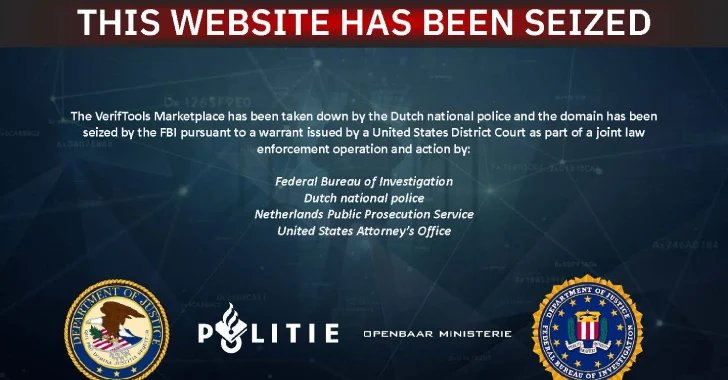
- Authorities from the Netherlands and the U.S. dismantled VerifTools, an illicit marketplace selling counterfeit IDs globally, seizing servers and domains, including verif[.]tools and verif[.]net.
- The platform generated fake driver’s licenses, passports, and ID documents for all 50 U.S. states and foreign countries, facilitating criminal activities like bypassing identity checks and accessing cryptocurrency accounts.
- Investigations revealed VerifTools linked approximately $6.4 million in illicit proceeds, and the operators claimed users were responsible for legal compliance, despite the platform’s criminal use.
- The takedown, involving over 21 virtual servers and physical infrastructure, aims to disrupt the production and sale of fake identities, highlighting law enforcement’s commitment to combatting identity fraud and cybercrime.
The Core Issue
Recently, authorities from both the Netherlands and the United States collaborated to dismantle a major illegal marketplace called VerifTools, which supplied counterfeit identity documents—including driver’s licenses and passports—used by cybercriminals worldwide to bypass security systems and commit fraud. The FBI’s investigation, which began in 2022 after discovering the platform’s role in stealing identities to access cryptocurrency accounts, revealed that VerifTools generated fake IDs for all 50 U.S. states and other countries, earning about $6.4 million in illicit profits. The operators of this marketplace, whose exact identities remain unknown, had been openly selling these falsified documents at affordably low prices, under the guise of legal usage, and even maintained an active presence on a Telegram channel. The crackdown involved seizing servers and shutting down domains—verif[.]tools, veriftools[.]net, and veriftools[.]com—resulting in the swift removal of the platform’s infrastructure and a strong message from law enforcement that they will relentlessly pursue those facilitating identity fraud, emphasizing the danger these counterfeit documents pose to financial safety and personal security.
Critical Concerns
Cyber risks like the dismantling of VerifTools exemplify how illicit online platforms facilitate severe threats to digital and financial security, notably through the production and sale of counterfeit identification documents used to bypass identity verification systems. This illicit trade, linked to around $6.4 million in proceeds, underpins a broader landscape where criminals exploit loopholes in Know Your Customer (KYC) protocols, enabling fraudulent activities such as identity theft, unauthorized access to cryptocurrency accounts, and various forms of financial fraud. The impact of these risks extends to organizations and individuals, as they compromise trust in digital transactions, enable illegal activities like bank fraud and phishing, and impose substantial costs on law enforcement and regulatory agencies seeking to combat cybercrime. The takedown of VerifTools underscores both the evolving sophistication of cybercriminal operations and the critical importance of robust cybersecurity measures, legal enforcement, and international cooperation to prevent and mitigate the proliferation of digital crime and its pervasive economic and social ramifications.
Possible Action Plan
The swift response to online marketplaces involved in illicit activities, such as the recent seizure of VerifTools’ fake-ID marketplace and their subsequent relaunch on a new domain, is crucial to minimize ongoing harm and prevent further exploitation. Prompt remediation actions can disrupt criminal operations, protect users, and uphold cybersecurity integrity.
Containment Measures
- Immediately take down or block access to the new domain
- Isolate affected systems and accounts to prevent wider compromise
Investigation & Intelligence
- Conduct thorough threat assessments to identify vulnerabilities
- Gather evidence to understand operational methods and cyber threat actors
Communication & Notification
- Inform relevant law enforcement agencies and industry stakeholders
- Notify affected users and provide guidance on security practices
Mitigation Strategies
- Implement domain monitoring to detect future relaunch attempts
- Strengthen digital defenses, such as multi-factor authentication and intrusion detection systems
Legal & Regulatory Actions
- Pursue legal actions to shut down the new domain
- Coordinate with legal authorities to establish a framework for ongoing enforcement
Prevention & Education
- Educate users about recognizing and avoiding fake-ID sites
- Develop policies to prevent similar operations in the future
Advance Your Cyber Knowledge
Explore career growth and education via Careers & Learning, or dive into Compliance essentials.
Explore engineering-led approaches to digital security at IEEE Cybersecurity.
Disclaimer: The information provided may not always be accurate or up to date. Please do your own research, as the cybersecurity landscape evolves rapidly. Intended for secondary references purposes only.
Cyberattacks-V1
