

Essential Insights
- The Scattered Lapsus$ Hunters’ farewell statement reveals their sophisticated operational security, strategic deception, and long-term planning, indicating a shift towards nation-state-level tactics rather than typical cybercrime.
- They engineered their silence as a tactical move to misdirect law enforcement, judging from their elaborate contingency plans and detailed understanding of security responses.
- The group hints at exploiting critical infrastructure vulnerabilities, including breaches involving airlines and major corporations, suggesting ongoing threats despite apparent operational pauses.
- This farewell likely signals a transformation rather than an end, with their techniques and innovations poised to influence future cybercriminal activities amid intensified international law enforcement efforts.
The Issue
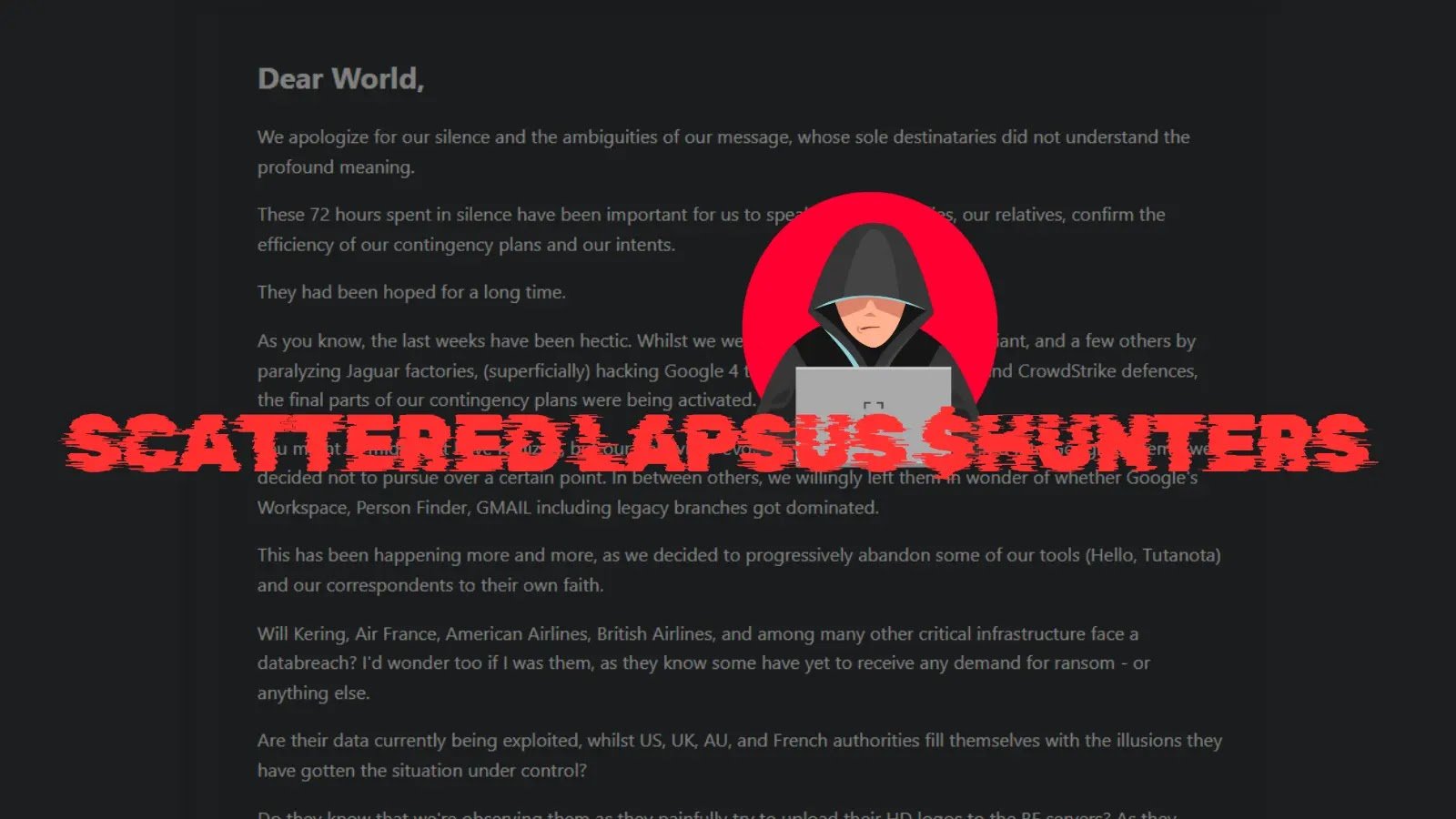
The cybercriminal group known as Scattered Lapsus$ Hunters announced their “farewell” on BreachForums, a move viewed by security experts as a strategic response to intense international law enforcement pressure rather than a genuine end to their activities. The group, which has incorporated advanced operational security measures akin to nation-states, claimed their recent 72-hour silence was a calculated effort to communicate with their families and test contingency plans, while simultaneously deploying distraction tactics to divert agencies like the FBI and Mandiant. Their statement implicates a broad network of cyberattacks targeting major corporations such as Google, Air France, and American Airlines, exploiting vulnerabilities in critical infrastructure and cloud services, and suggests that they have been monitoring ongoing investigations, even as arrests in France and elsewhere have disrupted their peripheral members. This demonstrates the group’s sophisticated blend of social engineering, technical prowess, and counterintelligence tactics, revealing a complex evolution in cybercrime that leverages strategic deception, international collaboration, and technological innovation, with their withdrawal likely a calculated reorganization rather than an abandonment of their operations.
Their high level of operational security, combined with claims of manipulating evidence and manipulating investigations, underscores their capacity for sophisticated countermeasures that challenge law enforcement efforts. This consolidation of multiple notorious groups—such as ShinyHunters and Lapsus$—into a unified, highly skilled entity indicates a new phase in cyber threat evolution, emphasizing human-centric vulnerabilities and supply chain security. The timing of their statement, amid mounting global enforcement actions and advisories, suggests that their decision to “go dark” is as much a defensive tactic as a form of protest against relentless investigations. Ultimately, while their public farewell signals a pause or shift, cybersecurity professionals are cautioned to remain vigilant, as the techniques and innovations pioneered by Scattered Lapsus$ are likely to influence future cybercrime operations, making the threat landscape even more complex and strategically sophisticated.
Critical Concerns
The farewell statement from the notorious cybercriminal group Scattered Lapsus$ Hunters reveals a highly sophisticated level of operational security and strategic deception, reflecting practices more akin to nation-states than typical cybercriminals. Their deliberate 72-hour silence was a calculated move to test contingency plans, mislead law enforcement agencies like the FBI and international authorities, and suggest they had more access than publicly acknowledged, notably in high-profile breaches involving Google and major airlines. This group’s integrated operations, combining social engineering, data theft, and AI-enhanced tactics, highlight ongoing vulnerabilities in critical infrastructure and third-party cloud services, especially through compromised OAuth tokens. Their apparent withdrawal amid escalating law enforcement pressure underscores the evolving nature of cyber threats—characterized by strategic deception, covert collaboration, and complex counterintelligence—posing persistent risks that will likely persist regardless of their apparent hiatus, as their tactics and innovations continue to influence future cybercriminal conduct.
Possible Actions
Understanding the key lessons from The Scattered Lapsus $Hunters Statement underscores the critical need for swift and effective responses to security incidents. Prompt remediation minimizes damage, restores trust, and prevents further exploitation.
Mitigation and Remediation Steps
- Incident Analysis: Conduct thorough investigation to identify vulnerabilities.
- Patch Systems: Apply necessary software updates and patches promptly.
- Enhance Security: Implement stronger access controls and multi-factor authentication.
- User Education: Train staff on best security practices and awareness.
- Monitor Activity: Increase vigilance through continuous monitoring and logging.
- Communication: Transparently inform stakeholders about the breach and recovery plan.
- Legal Compliance: Ensure adherence to relevant regulations and reporting requirements.
- Post-Incident Review: Analyze response effectiveness to improve future strategies.
Stay Ahead in Cybersecurity
Stay informed on the latest Threat Intelligence and Cyberattacks.
Learn more about global cybersecurity standards through the NIST Cybersecurity Framework.
Disclaimer: The information provided may not always be accurate or up to date. Please do your own research, as the cybersecurity landscape evolves rapidly. Intended for secondary references purposes only.
Cyberattacks-V1
