

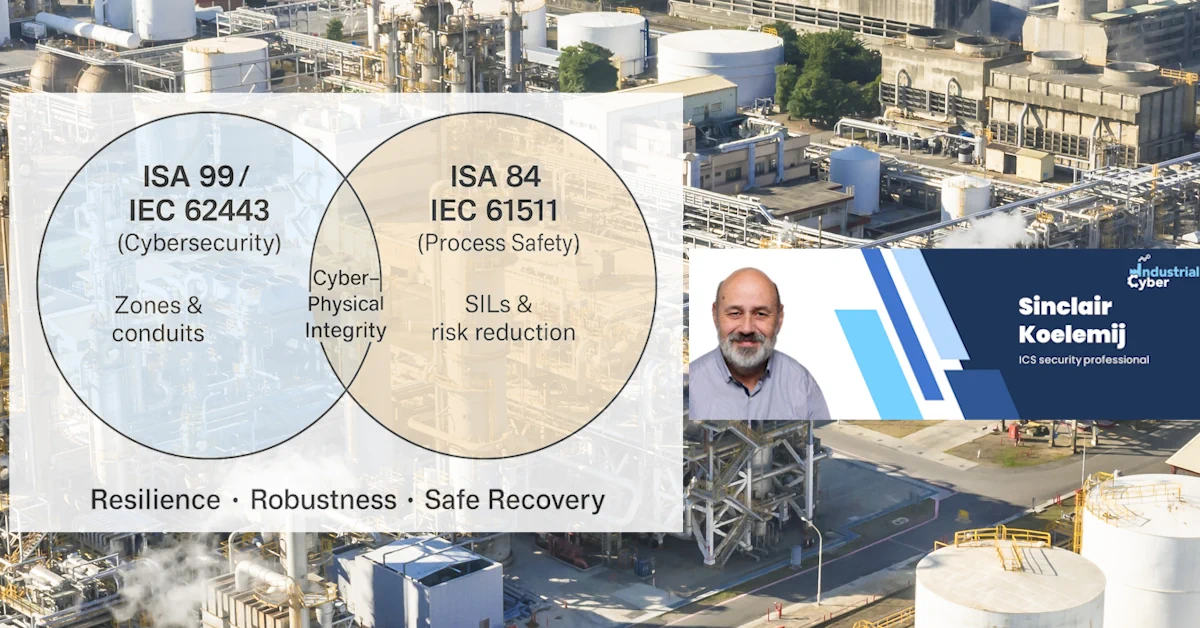
Summary Points
- Cybersecurity and process safety are now inherently linked due to integrated control systems, as demonstrated by the 2017 Triton attack that targeted safety systems, exposing their shared vulnerabilities.
- Horizontal standards like IEC 62443 are insufficient for high-hazard industries because they lack the capability to link cybersecurity measures directly to process-risk severity, necessitating a vertical, process-specific framework.
- A unified ISA 99 / ISA 84 approach is essential, combining cyber governance with process safety to create a comprehensive, risk-based risk management model that ensures safety and operational resilience under all conditions.
- Transitioning from isolated, industry-agnostic standards to a converged, vertical model—mirroring IEC 61511’s evolution—will enable more effective cyber-physical risk mitigation tailored to the unique hazards of the process industry.
The Issue
The narrative describes how the once-distinct worlds of cybersecurity and process safety in the industrial process sector have become inextricably linked due to increasing interconnectivity. Historically, plants kept safety systems isolated, preventing cyber threats from directly influencing critical safety functions. However, modern plants now integrate safety and control networks to enhance operational visibility and efficiency, inadvertently exposing themselves to cyber risks. The 2017 Triton attack — which targeted safety instrumented systems with the intent to disrupt safety functions — starkly revealed how cyber threats can directly threaten physical safety, blurring the boundary between digital security and physical protection. Existing standards like IEC 62443, designed for broad industry application, fall short because they focus on system-level security rather than translating process hazard severity into actionable cybersecurity requirements, similar to the risk-based approach of Safety Integrity Levels (SILs). Consequently, the current framework cannot adequately manage the complex, risk-driven environment of high-hazard industries, emphasizing the urgent need for a vertical, integrated standard. Sinclair Koelemij advocates for unifying cybersecurity and process safety disciplines under a single, converged framework—drawing inspiration from functional safety standards—centered on robustness, resilience, and process-safety integration to ensure both digital and physical protection in today’s interconnected, cyber-physical plant environments.
Security Implications
The convergence of cybersecurity and process safety in the process industry has become a critical imperative, as interconnected control systems and digital interfaces now underpin both safe operations and operational efficiency, exposing plants to heightened cyber-physical risks. The notorious 2017 Triton attack exemplified how cyber threats can bypass traditional defenses, directly targeting safety systems with potentially catastrophic consequences. Current standards like IEC 62443, designed to provide broad cybersecurity frameworks, fall short in addressing the unique hazards of high-risk processes because they focus primarily on system architecture rather than the profound influence of process-specific risks and physical safeguards. This disconnect hampers the industry’s ability to reliably quantify and mitigate cyber-induced hazards, especially as digital and physical systems become inseparable. The future must involve a vertically integrated approach—merging cybersecurity, automation, and process safety into a unified standard—that emphasizes risk-based mitigation, resilience, and safety-oriented recovery, ensuring that protective measures reflect the severity and nature of process hazards. Only through such a cohesive framework can the industry adequately safeguard assets, personnel, and the environment against evolving cyber-physical threats, recognizing that in today’s connected operations, the line between accidental failure and malicious interference has effectively vanished.
Possible Remediation Steps
Recognizing the urgency of timely remediation is essential in safeguarding our cyber-physical systems, especially as the lines between industrial security standards like ISA 99 and ISA 84 become increasingly intertwined. Failing to address vulnerabilities promptly can lead to catastrophic failures, operational disruptions, or even safety hazards. Swift, coordinated action ensures the resilience of critical infrastructures and maintains trust in technological advancements.
Mitigation Strategies
-
Integrated Frameworks: Develop unified security protocols that incorporate elements from both ISA 99 and ISA 84 to address comprehensive risk management.
-
Rapid Detection: Implement real-time monitoring systems to quickly identify and assess security breaches or system anomalies.
-
Incident Response Plans: Establish clear, rehearsed procedures for immediate action when vulnerabilities or threats are detected.
-
Prioritized Patching: Adopt a structured approach to promptly apply security patches and updates to vulnerable components.
-
Staff Training: Conduct ongoing training to ensure personnel are equipped to recognize issues and respond effectively.
- Stakeholder Collaboration: Foster communication between cybersecurity teams, operations, and management for coordinated remediation efforts.
Remediation Approaches
-
System Segmentation: Isolate critical components to limit the spread of cyber threats and contain potential damage.
-
Vulnerability Assessments: Regularly perform comprehensive audits to identify and remediate security weaknesses.
-
Backup and Recovery: Maintain robust backup systems to facilitate swift restoration of operations post-incident.
-
Policy Updates: Continuously revise security policies to reflect evolving threats and standards convergence.
-
Incident Drills: Conduct simulated attacks to test response readiness and improve remediation strategies.
- Technical Upgrades: Invest in advanced security technologies that support rapid threat mitigation and system resilience.
Continue Your Cyber Journey
Stay informed on the latest Threat Intelligence and Cyberattacks.
Explore engineering-led approaches to digital security at IEEE Cybersecurity.
Disclaimer: The information provided may not always be accurate or up to date. Please do your own research, as the cybersecurity landscape evolves rapidly. Intended for secondary references purposes only.
Cyberattacks-V1
