

Essential Insights
-
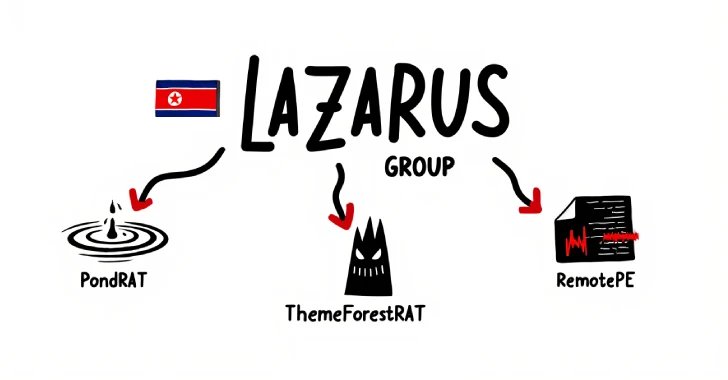
Lazarus Group Attack: A North Korea-affiliated hacking group, Lazarus, executed a sophisticated social engineering campaign targeting a DeFi organization, leveraging cross-platform malware including PondRAT, ThemeForestRAT, and RemotePE.
-
Social Engineering Tactics: The attack involved impersonating an employee via Telegram and using fake scheduling websites to gain trust for access to sensitive systems.
-
Malware Evolution: The attack chain involved deploying multiple Remote Access Trojans (RATs), initially using the basic PondRAT, then transitioning to the more advanced ThemeForestRAT and RemotePE, indicating a strategic escalation in techniques.
- Complex Features: While PondRAT serves as a primitive entry point, ThemeForestRAT offers enhanced functionalities, including file manipulation and command execution, positioning it as a stealthier option for ongoing reconnaissance and control.
Lazarus Group’s New Malware Trilogy
The Lazarus Group has expanded its malware capabilities with three new tools: PondRAT, ThemeForestRAT, and RemotePE. These pieces of malware are designed to infiltrate systems through social engineering tactics. The group, linked to North Korea, targeted a company in the decentralized finance sector. They impersonated an employee and created fake meeting schedules on platforms like Calendly. Eventually, this led to compromising an employee’s system. Experts explain this attack showcases the group’s ability to effectively exploit human psychology.
Moreover, the attack begins with the deployment of a loader, PerfhLoader, which introduces PondRAT. This malware allows for basic functions such as reading files and executing commands. In tandem, it uses additional tools like keyloggers and proxy programs to enhance data collection. The Lazarus Group has applied these methods over the past few years, utilizing different RATs for various stages of their attacks.
Understanding the Threat Landscape
ThemeForestRAT adds another layer of functionality, enabling further actions within the compromised system. This malware can monitor Remote Desktop sessions and execute multiple commands like enumerating files or executing additional tasks. Its stealthy nature allows it to operate without being detected.
In contrast, RemotePE, a more advanced RAT, targets high-value victims and provides extensive capabilities. Experts note that while PondRAT serves basic needs, its primary goal remains clear: establishing a foothold for more complex operations. The evolution of these malware tools signifies a troubling trend in cyber threats, emphasizing the need for heightened security awareness in organizations. As tactics become more sophisticated, the imperative to stay informed grows stronger.
Stay Ahead with the Latest Tech Trends
Explore the future of technology with our detailed insights on Artificial Intelligence.
Explore past and present digital transformations on the Internet Archive.
DataProtection-V1
